Purdue Turf Fertilizer Calculator
Not sure about something?
Enter the fertilizer analysis and the area you are treating. Results update as you type.
Saved products
Saved on this device only — nothing is sent anywhere. Prices are stored too, so clear them if you share this device.
What to apply
Fill in the analysis, a target rate and your area. Answers appear here as you type.
Close to the limit
You are near the maximum recommended for one application. Consider splitting this into two passes of 1 pound or less per 1,000 ft².
Too much for one application
This applies more than is recommended at once. Divide it into two or more passes of 1 pound or less per 1,000 ft².
Excess nitrogen and phosphorus are partly responsible for declining surface water quality, and have been linked to eutrophication in ponds, lakes and streams.
Printed
Enter what you applied and the ground you covered. Results update as you type.
What you applied
Enter an analysis, an area and how much you applied.
Close to the limit
That is near the maximum recommended for a single application.
More than recommended
That is more than is recommended for one application. Consider keeping future applications to 1 pound or less per 1000 ft2.
Excess nitrogen and phosphorus are partly responsible for declining surface water quality, and have been linked to eutrophication in ponds, lakes and streams.
Printed
Enter two products to see which is the cheapest source of each nutrient, and add up to five. Granular and liquid can be compared side by side. Results update as you type.
Cost per pound of nutrient
Enter a price, a container weight and at least one nutrient percentage for a product.
This ranks the cost of the nutrient itself. It does not account for slow versus quick release, coverage, or what it costs you to apply.
Printed
Fertilizer types
Granular fertilizers are the most common choice for lawns. They are dry, applied with a rotary or drop spreader, deliver a large dose of nutrients, and should ideally be watered in afterwards.
Liquid fertilizers are concentrates, usually applied to lawns with a hose-end sprayer. They suit smaller amounts and work well as a supplement.
What the nutrients do
- Nitrogen (N)
- Drives greening and growth.
- Phosphorus (P2O5)
- Stores and moves energy in the plant, and helps new plants establish more quickly.
- Potassium (K2O)
- Helps the plant tolerate stress, such as drought and cold.
How to read a label
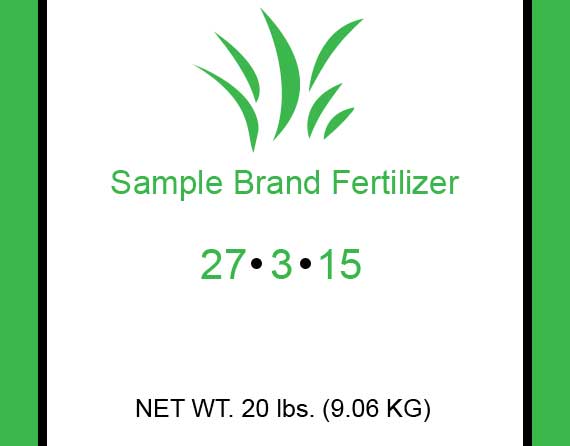
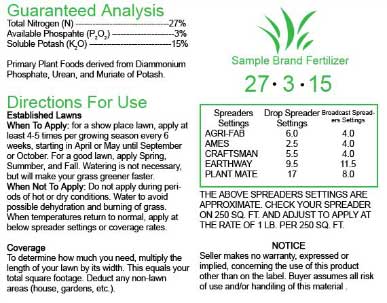
Select a numbered area of the label, or read the notes below it.
-
Brand
This is the product's name.
-
Analysis
The fertilizer analysis (nitrogen – phosphorus – potassium): the percentage by weight of each nutrient. Maintenance fertilizers normally run about 4:1:2, a starter fertilizer about 1:2:1, and a zero-phosphorus fertilizer 1:0:1 or similar.
-
Bag weight
How much the bag weighs.
-
Guaranteed analysis and nutrient sources
The percentages of each nutrient and where they come from. This also tells you how quickly the nitrogen is released: coated urea is slow, lasting 6–12 weeks, while urea alone is quick, lasting 3–5 weeks.
-
Directions for use
How to use the product.
-
Spreader settings
Which spreaders suit this product, and what to set them to.
-
Legal notices
Legal notices for the product.