Author: Zac Reicher

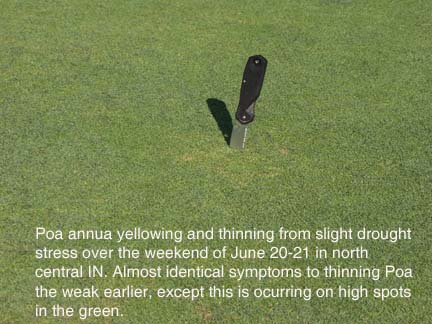
Finicky Poa annua Yellowing and Thinning on Greens

In spite of the cool and dry weather, Poa annua continues to yellow and sometimes thin on golf greens. Last week Poa annua was thinning and dieing in low areas from too much water, heat, and humidity (photo). However, the cool dry weather over...
Read More
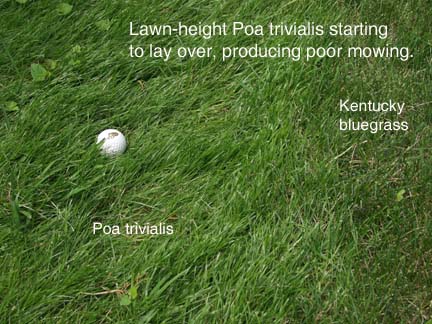
Summer stress of Poa annua and Poa trivialis in Lawns and Sports Fields

Poa annua (annual bluegrass) and Poa trivialis (rough bluegrass) in athletic fields and lawns are starting to show signs of stress. The signs of stress include laying over (poor mow-ability), yellowing, and thinning. Patches of these fine-bladed grasses seemingly die overnight with even a...
Read More

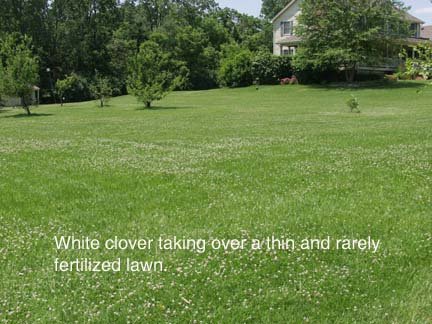
White Clover in Golf Courses, Sports Turf, and Lawns

The small white flowers of white clover are very visible right now and it may appear that clover is taking over, especially under-fertilized turf areas. Clover is a legume and is very competitive under low N conditions, so increasing annual...
Read More

Dealing With Flood Damage

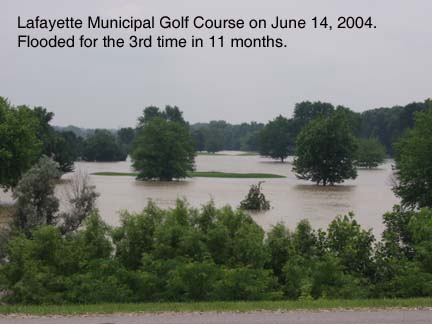
Though flooding damage so far this year is not as bad as last year, a number of areas have been hard hit with rainfall the last week (see the photo of Lafayette Municipal Golf Course). We don’t expect damage to...
Read More

Doug Richmond Joins Turf Program in Entomology Research

Dr. Doug Richmond has recently accepted the turfgrass entomology faculty position at Purdue University. Doug is the first of the projected six positions of Purdue’s initiative on sustainable urban ecosystems. Dr. Richmond joins the Turf Program after completing his M.S....
Read More

Midwest Regional Turf Field Day on July 27

The Midwest Regional Turf Field Day will be held on July 27 at the Wm H Daniel Turfgrass Research and Diagnostic Center in West Lafayette. This is a great opportunity for turf professionals to view the latest in turfgrass research,...
Read More

June Checklist

With the constant rains in May and now June, many turf management practices have been delayed and many practices have to be modified as a result of the rain:  Fertilization: With all extended growth period using up much of the soil...
Read More

Early Dollar Spot on Golf Courses This Year

If you’re lucky enough to be in the areas of Indiana that have received ample rainfall, you are unfortunately starting to see dollar spot. The excess rain in parts of the state triggered rapid plant growth and infrequent mowing, which...
Read More

Bumper Crop of Seedheads This Year

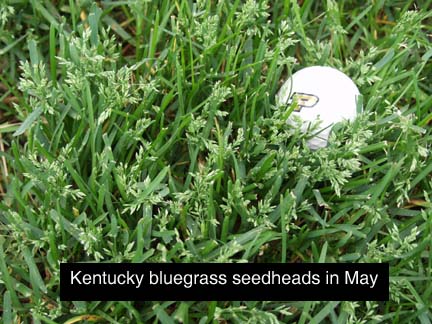
Cool-season turfgrasses such as Kentucky bluegrass and perennial ryegrass are now producing seedheads. This natural phenomenon is induced by daylength, but the intensity of seedhead production is affected primarily by temperature and is likely the cause of the above average...
Read More

Dallisgrass

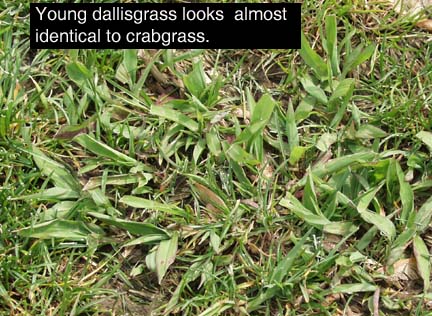
Dallisgrass is currently emerging in southern Indiana. This perennial grassy weed is almost identical in appearance to crabgrass and can be problematic in the southern half of Indiana. Dallisgrass is often mistaken for crabgrass but it has slightly less hairy...
Read More

Poa trivialis in Athletic Fields

As a follow up to last week’s Turf Tip, Poa trivialis control in athletic fields is far more complicated than in lawns. Poa trivialis is a weed because it will go dormant in July or August (perfect timing before the football season), but will...
Read More

Time to Switch Crabgrass Control Strategies

Crabgrass is starting to germinate throughout much of the state and thus preemergence herbicides will be of limited effectiveness. Instead, combinations of preemergence plus postemergence herbicides will be most effective for the next month or so. The postemergence herbicide will...
Read More

May Fertilizer

As turfgrass growth is beginning to slow, it's time to consider fertilizing your lawn. Applying fertilizer now should not increase vertical growth dramatically as long as moderate rates of nitrogen are used and will help your lawn retain it’s color...
Read More

Kentucky bluegrass for fairways?

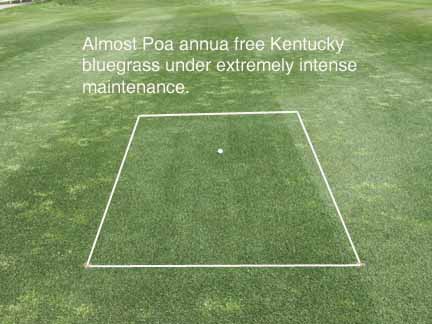
There’s been some interest in the new low-mow varieties of Kentucky bluegrass for fairways in IN. In response to this, we initiated a research study in August of 2002 where we established a blend of top-performing low-mow Kentucky bluegrasses on...
Read More

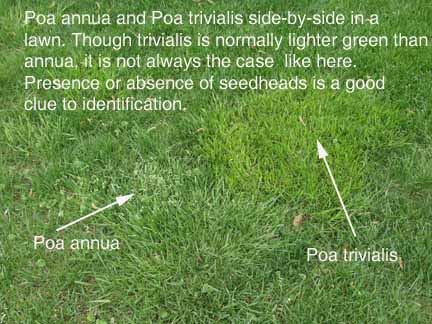
Poa annua, Poa trivialis in Lawns and Athletic Fields

Annual bluegrass (Poa annua) and rough bluegrass (Poa trivialis) are becoming common weeds in lawns and athletic fields, though they have been a problem on golf courses for a long time. Both of these grasses are very visible right now...
Read More

Sulfur is not Effective for Lowering pH of Turfed Soils

Soil testing is important in turf to help determine the soil pH and fertilization needs, especially for potassium and phosphorus. Acceptable soil pH for turf is between 6.0 and 7.5. Some distributors and soil testing labs will recommend applying sulfur...
Read More

Prevention of Dog Urine Spots

We have received a ton of questions on dog urine spots this year, probably because it has been a very dry April. Dog urine will burn leaf blades because the high concentration of salts in the urine will pull water...
Read More

Bermudagrass for Southern IN Soccer and Football Fields

As stated in last year’s Turf Tips on 4/14/03, seeded Bermudagass is a great grass for southern IN athletic fields. We now have a brand new extension publication on our web page entitled AY-325-W: Bermudagrass for Southern Indiana Athletic Fields....
Read More

Turf Science Program Awarded the School of Agriculture’s 2004 Team Award

Dean Vic Lechtenberg announced at the GCSAA Conference in San Diego that the Turfgrass Science Program has won the prestigious Team Award for the School of Agriculture. This award is given annually to a team of faculty and staff who...
Read More

Lee Schmidt (BS ’70) Recognized as Distinguished Ag Alumni last Weekend

Lee Schmidt was honored as a Distinguished Ag Alumni on April 2 on campus. Lee Schmidt has a distinguished career as a golf course designer and developer. Lee is a co-owner of Schmidt-Curley Golf Design and has been involved with...
Read More