July 7, 2026: Summer Sequels
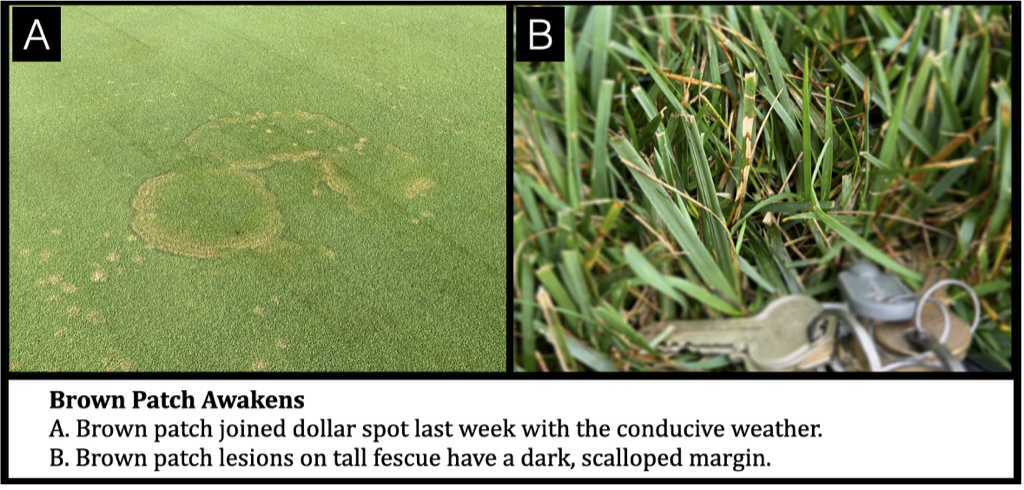
Summer sequel of heat approaches; rainfall chances lessen perhaps furthering flash drought symptoms; brown patch awakens; dollar spot severity heightens; Curious about dollar spot recovery? Join us at Field Day on July 21.
Weather
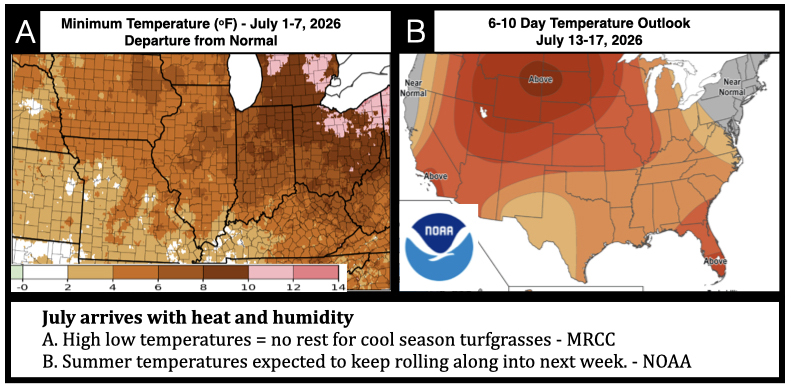
After a fairly mild month of June, the late June – early July span delivered exactly the kind of stretch that puts us back on our toes. A punishing heat dome parked over the region from June 29 through the Fourth of July holiday, pushing Indianapolis highs into the low-to-mid 90s and dragging heat index values into the 105–110°F range across central Indiana. Overnight lows barely dipped into the 70s during the worst of it, denying turfgrasses their needed nighttime recovery window.
A weak cold front finally pushed through over the weekend, and by highs have settled back to into seasonal norms. It’s a welcome breather, but July is still predicted to July. The forecast calls for a return to hotter-than-normal conditions across nearly the entire country outside the Pacific Coast. In other words, the heat dome is reloading.
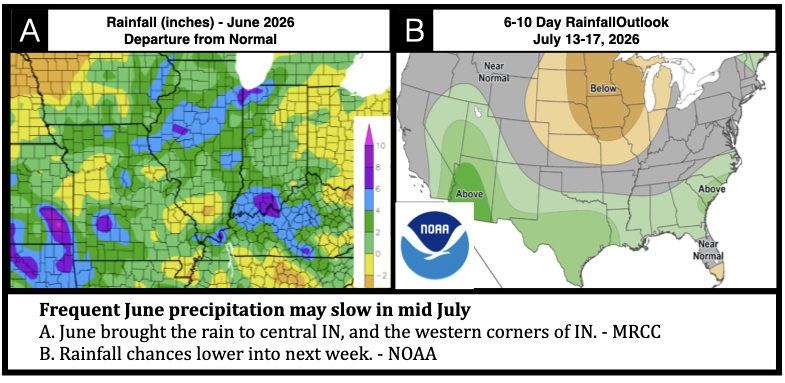
June provided above average rainfall for much of the region except for the Fort Wayne area and southern Illinois. Pockets of heavier, above average rainfall fell along the Ohio River Valley, central Illinois and the NW corner of the state. Rainfall chances are lower over the next few weeks. We observed a few instances of wet wilt or flash drought on lawns and commercial areas in early July. The problem will likely broaden further, especially on areas with high thatch and/or roots compromised by the overabundance of water in soils through May and June. This issue was explained in detail in the previous report.
Brown Patch Awakens
Brown patch had a quiet first half of the season, but the same heat and humidity that fueled dollar spot flipped the switch on tall fescue lawns and some bentgrass areas by the end of June. Look for the classic dark-brown-margined, tan-to-white-centered leaf lesions. Remember that unlike dollar spot’s hourglass shape, brown patch lesions tend to be scalloped and irregular across the leaf blade.
With heat and humidity back on the horizon, expect brown patch outbreaks to intensify. On tall fescue lawns specifically, the strobilurin chemistries such as azoxystrobin outperform the older DMI and benzimidazole options (propiconazole, myclobutanil, thiophanate-methyl), which are less mobile in the plant. A single, well-timed curative application after scouting typically beats an unnecessary preventive program started too early in spring. If wetter conditions develop later this month, Pythium blight may also join the party.
Dollar Spot Still All the Rage
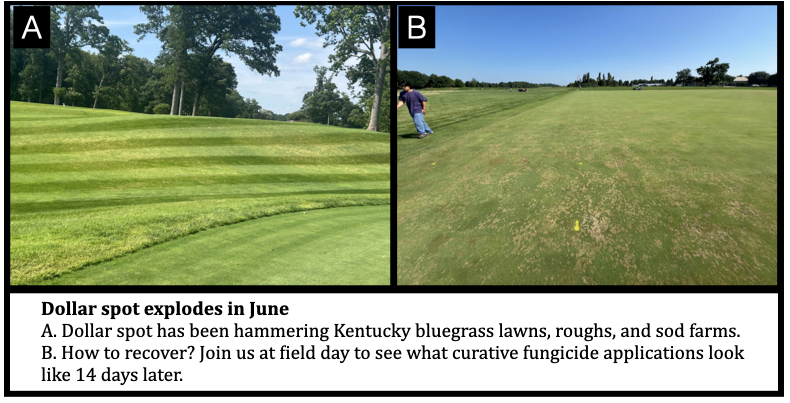
The dollar spot record keeps skipping and the amp got turned way up. In early June, dollar spot probability as forecasted by the Smith Kerns model eclipsed the 50% threshold and dollar spot outbreaks quickly followed suit. Reports from throughout Indiana noted aggressive dollar spot on creeping bentgrass fairways, tees and greens and on Kentucky bluegrass lawns, roughs and sod farms. As a golf course superintendent put it to me last week, “14 days on the label really means 14 days right now.”
Fungicide breakthroughs are being reported on bentgrass fairways at several courses. Dollar spot is the “Poa annua” of the turfgrass pathology world with a wide number of strains and biotypes. This genetic diversity lends itself to the development of fungicide resistance. Dollar spot populations have developed resistance to broad classes of fungicides including the benzimidazoles (thiophanate-methyl), the dicarboximides (e.g. iprodione), the DMIs (e.g. propiconazole) and most recently the SDHIs (e.g. boscalid). Unfortunately, the only current way of determining if a population is resistant and the failure is not from another cause is lab testing. This involves sampling, isolation of the pathogen and conducting a mycelial growth assay. The process which can take quite a bit of time.
What to do if you have an outbreak that slipped through? Higher curative rates are necessary and tank mixing a contact such as fluazinam (Secure) or chlorothalonil (Daconil) with a systemic is suggested. In limited previous field research, the SDHIs, including fluxapyroxad (Xzemplar) and pydiflumetofen (Posterity) have provided fairly quick recovery. Also, a small extra shot of nitrogen (~0.25 lb N/1000 sq ft on Kentucky bluegrass; less on creeping bentgrass) can enhance recovery.
What to expect two weeks after an application? Join us at field day in two weeks to see just that. We let a creeping bentgrass putting green research area get hammered (see photo B above), and put curative rates of eight different fungicides to the test with an application today. We also either watered in these fungicides with 0.2 inches of post application irrigation right after the application or applied to a dry canopy and let them be. How will the treatments promote recovery? I’m also curious.
Purdue Turfgrass and Landscape Field Day – Tuesday, July 21st (Register Here)
The agenda is out and can be seen below. We have a ton of great information lined up that cover all gamuts of the turfgrass industry. For golf, we’ll be talking about autonomous mowing, new disease resistant varieties, and maximizing fungicide impact. Lawn improvement practices, nitrogen fertilization, weed control, logos and line painting for sports fields, and various other topics are on tap. Hope you can find the time to join us.
Lee Miller
Extension Turfgrass Pathologist – Purdue University
Follow on Twitter: @purdueturfpath
Follow on LinkedIn: @purdueturfpath