August 14, 2026: Awful tired boss
Rain, rain go away… threat of saturated soil profiles in the toughest time for cool season turfgrass; four foliar diseases that have been and are now becoming problems.
Weather
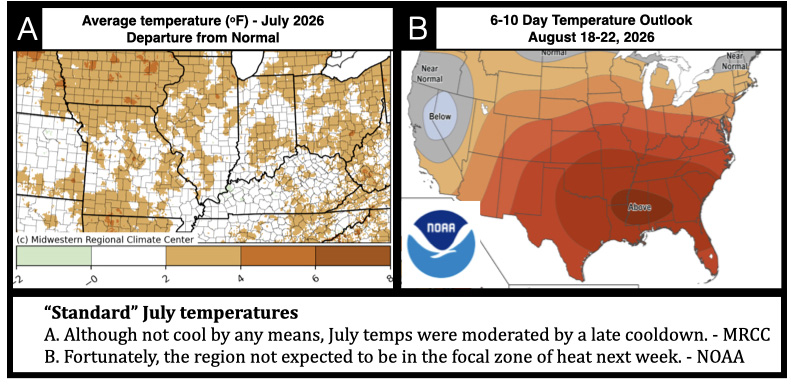
Extraordinarily high temperatures have not been the theme thus far this summer. Indianapolis posted 10 days in the 90s early in July but also had an extended break later in the month with highs in the 70s and even a low of 57 F on July 23. August has posted a few days right at the 90-degree high mark, but nothing too severe. More importantly, nighttime temperatures also haven’t had a sustained spike into the mid and high 70s like last year. Cool season turfgrass growth has been fairly consistent and heat stress is low, especially compared to last summer’s 4-6 degrees above normal temperatures in both June and July.
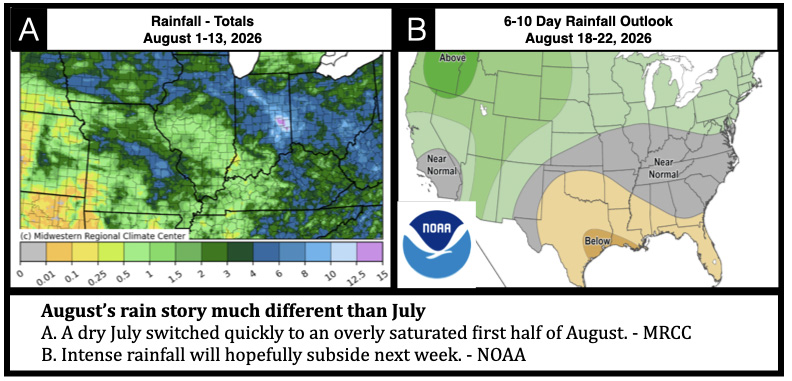
The story instead has been the intense rainfall and consistent humidity. Lower temperatures = higher relative humidity. Add in our corn sweat and “London fog” type of mornings were commonplace in July. Apart from Chicago, western Kentucky and the southern tip of Illinois, most of the region had slightly below average rainfall in July. Boy, has that changed in August. A static front has produced waves of heavy rainfall over the past week, saturating a diagonal swath from Chicago across Indiana into Cincinnati with 6, 8 and up to 15 inches of rainfall. For perspective, the average for the month is 3.2 inches. The White River crested to a record level causing severe flooding and disastrous impacts to those in Noblesville, Muncie, Anderson and others in its path. Thoughts and prayers to those impacted.
Tired, soggy turfgrass
August is traditionally the most difficult time for cool-season turfgrass. Many miles have been logged in the marathon of summer, and the remainder of the race towards the finish line of autumn needs to happen with tired legs, or in our case, tired roots. Recovery is near, but the physiology and metabolism of the plant is at its weakest point, requiring the vigilance of care from turfgrass managers (who also are tired). As John Coffey (played by Michael Clark Duncan) said, “Awful tired boss, dog-tired”.
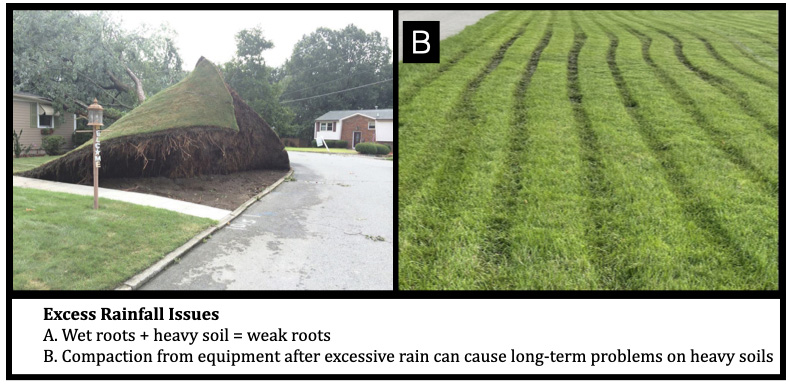
The saturated conditions from this week’s storms will not help matters. Roots need air to respire, grow and function. A saturated root profile displaces oxygen in pore space with water, causing a condition that may be called wet wilt. In this scenario, most commonly observed on golf putting greens with poor drainage and/or high organic matter, a double-edged sword is at play. One, the plant can’t take up water or nutrients because the roots can’t function properly from the lack of oxygen. Two, if high temperatures occur, the water in the soil profile gets hot and stays hot. Soggy hot root syndrome. Additionally, soil microbial activity is reduced, and switches from aerobic microflora which perform services such as nutrient release and thatch reduction which help the plant to anaerobic microbes which can be detrimental as with black layer.
Below are a few things to think about in this scenario.
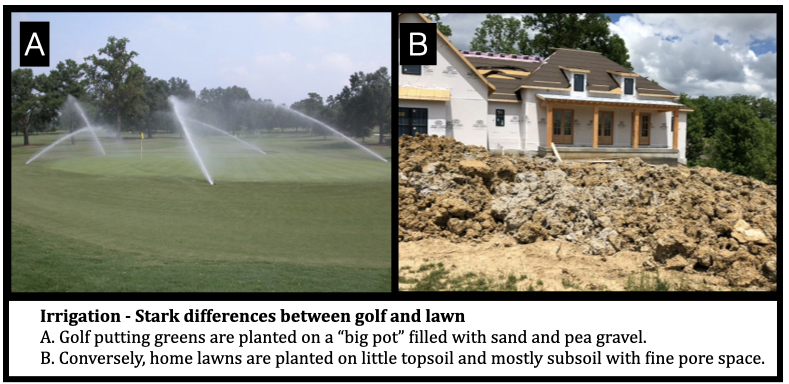
- Turn off irrigation. While seeming painfully obvious to the professionals, the act of turning off the in-ground irrigation controller during excessive rainfall periods still goes unattended, particularly on home lawns. If irrigation is left running and some dry down is not allowed to occur, the root system will be compromised, the potential for disease activity increases, and plant nutrition will be lost.
- Soil water/compaction management. For lawns impacted by floods, wait for a dry down in September and consider a hollow tine aerification. Rainfall and flooding alone can compact heavy soil and during the fall this can be a good time to combine some overseeding, fertility and aerification to encourage recovery.
On golf putting greens, vent and poke holes with solid tine aerification as soon as the rains pass and the soil structure will allow it. Going too soon after a heavy rain can cause some lifting and shearing. Light weight rolling after venting may help settle and smooth the green. Wetting agent applications will still need to be watered in, so gauge with a soil corer prior to application to determine if post-application irrigation and the wetting agent will travel down into the profile.
- Mowing/Traffic Threat. Equipment and heavy, saturated soils don’t mix. Compaction and turfgrass damage from mowing with heavy equipment can cause issues well after the storm has passed. If the mower tracks, get off it, wait and relax.
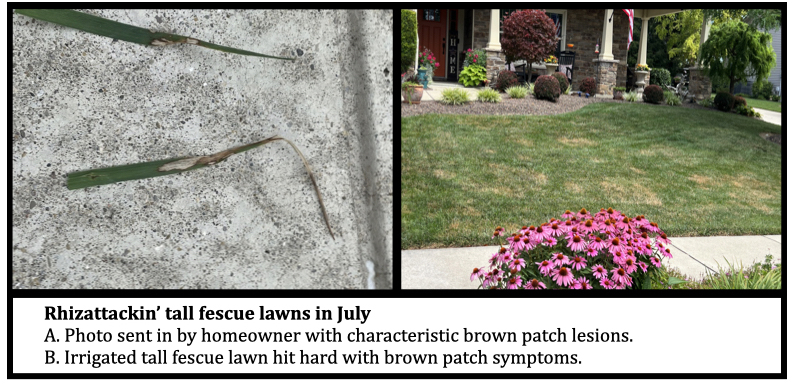
- Disease Threats. On lawns, foliar diseases will be primed even further with high rainfall and excessive humidity. Fortunately, temperatures will likely not get high enough for Pythium blight to be a concern, but the likelihood of the four noted below will greatly increase in the next few weeks. As noted below, if nitrogen hasn’t been applied all summer, consider applying a lighter 0.5 lb N/1000 sq ft in the next few weeks to supplement growth and nitrogen removal from excess rainfall.
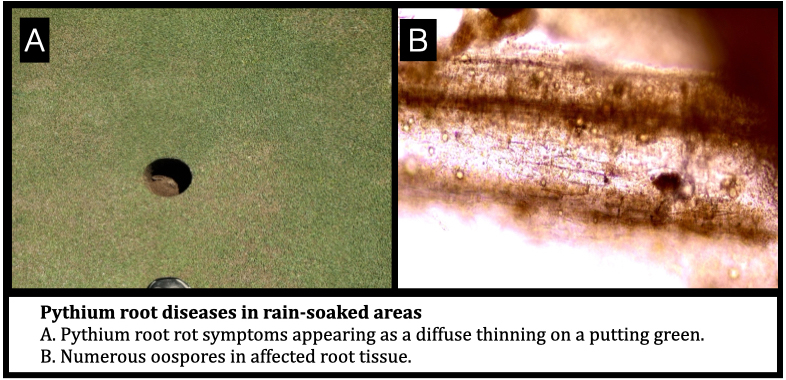
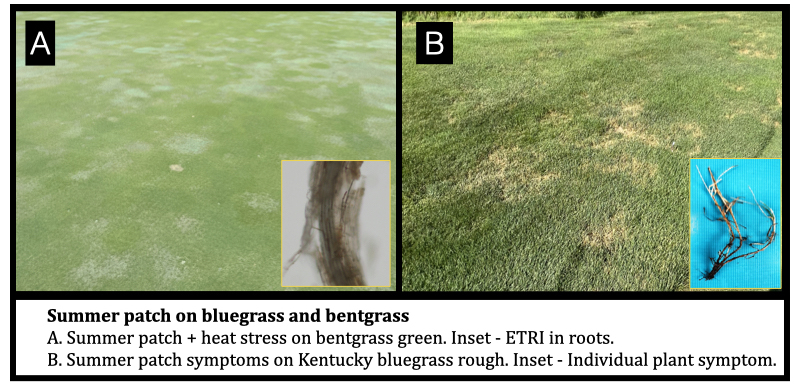
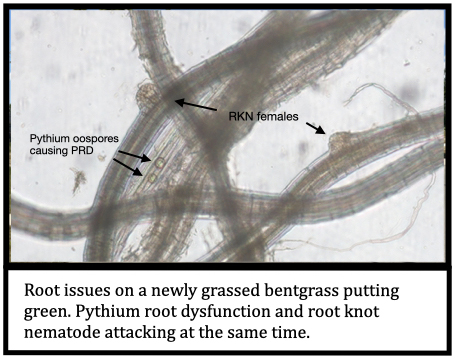
On golf putting greens, where to start? Saturated soil conditions in mid-August are not a recipe for success. Hopefully, a good base of disease prevention has been set with cultural practices and fungicide scheduling. Pythium root rot is the major concern since flooding primes the pathogen to quickly produce zoospores that can facilitate infection. If watered-in applications of picarbutrazox (Serata) or cyazofamid (Segway) haven’t been part of your program, this is the time to strongly consider it. Other soilborne pathogens such as take-all patch and summer patch, will also gladly walk through the open door of an oxygen deprived root system, so put prevention of those on your radar with watered in strobilurin, DMI or SDHI fungicides.
Lastly, consider anthracnose which is more severe in low fertility conditions. While our annual bluegrass research green has been getting hammered over the past month, bentgrass samples are also coming in showing early signs of basal rot. Recent rains have likely leached nutrients, including nitrogen, through the sandy soil profile. Using clipping volume as an indicator, a small addition to your spoon-feeding program may help in avoiding anthracnose issues. Along with a small bump in nitrogen, consider micronutrients, like manganese, which may also aid with patch disease suppression.
A Fearsome Foursome
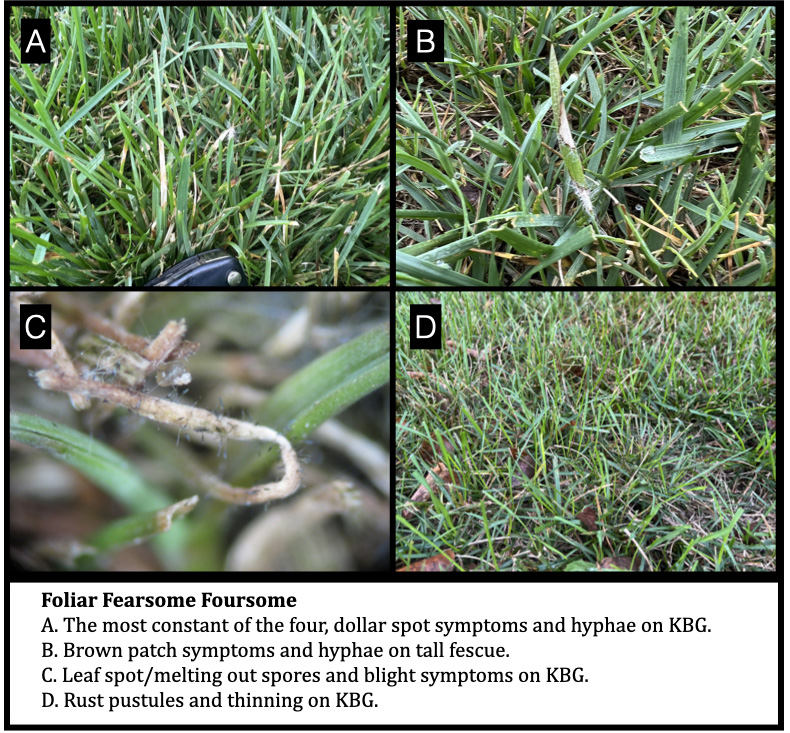
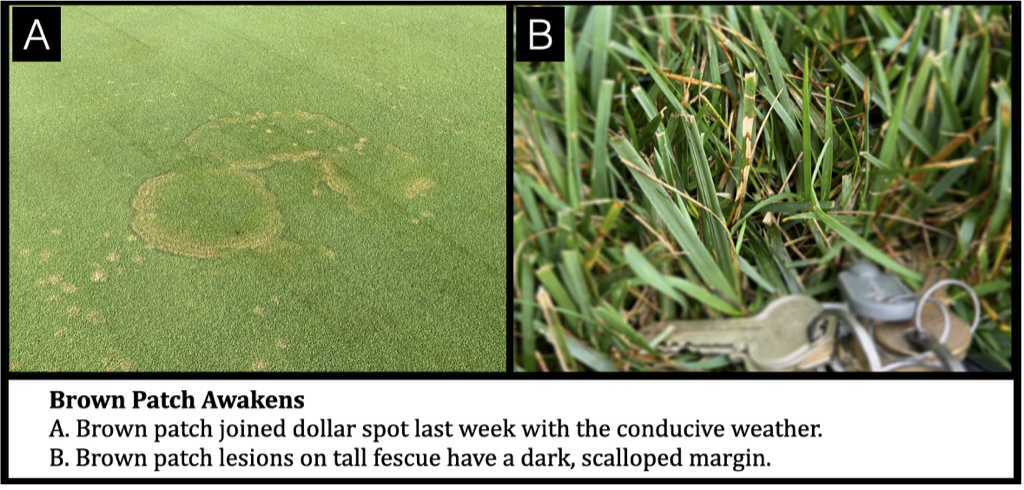
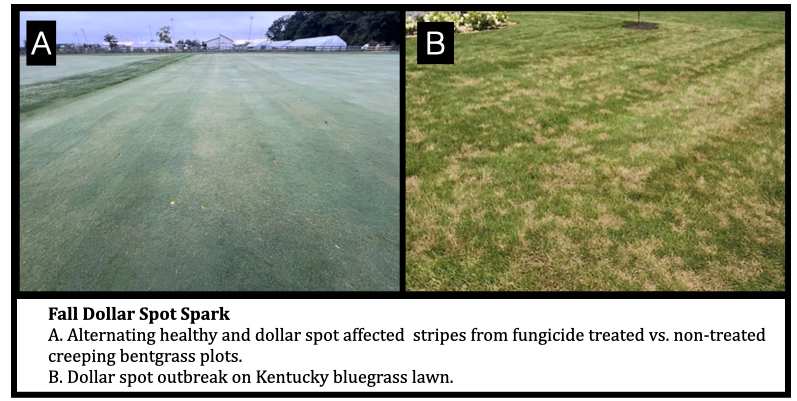
With the constant humidity and now more than adequate rainfall, foliar diseases have been problematic this summer. Joining dollar spot (Deacon Jones) and brown patch (Merlin Olsen) discussed in the previous report, leaf spot/melting out (Rosey Grier) and rust (Lamar Lundy) have joined the group in the past two weeks.
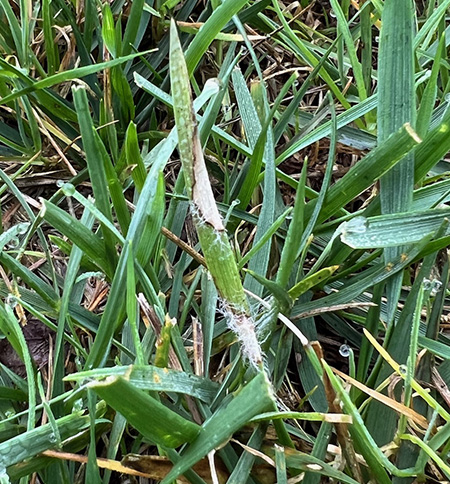
Leaf spot/melting out caused by Bipolaris spp., often B. sorokiniana in Indiana, can be a significant issue on Kentucky bluegrass lawns. For the first time this year we observed leaf spot (not red leaf spot caused by Drechslera spp.) in one of our research studies on bentgrass this summer. Interestingly, this disease is also a considerable disease issue on ultradwarf bermudagrass putting greens. The pathogen, unlike most others, can infect all plant parts including leaf, rhizomes and roots, making the disease fairly severe when populations and infection are high. Fortunately, this disease is not a common occurrence and is often limited to younger stands with attempted spring/early summer seeding. Many fungicides provide suitable control of this disease.
Rust is often overlooked and minor, but in the last few days we’ve observed some thinning and impact on Kentucky bluegrass. The disease, caused by Puccinia spp., is characterized and first noticed by orange “rust” pustules of urediniaspores that stain shoes. Darker spores called teliospores, can be observed in early fall, which can be used to identify the species. Rusts often tell a story of turfgrass need, with nitrogen fertility, compaction, irrigation or other stressors required for disease infection. Older Midnight varieties of Kentucky bluegrass are susceptible, so planting other varieties or blends can mitigate damage. Fungicides are not suggested since rust doesn’t kill the turfgrass and adding fertilizer or other cultural practices normally reduces or eliminates it.
Field Days
The Purdue Turf & Landscape Field Day was a great success on July 21, and thank you to the 480+ attendees that joined us. If you skipped it this year, you missed out on good information on autonomous mowers, curative disease control and interseeding, and that’s just from the pathology crew. Consider making it an agenda item next year.
For those attending the IPLLA field day next week at the Hendricks County Fairgrounds, I look forward to seeing you there!
Lee Miller
Extension Turfgrass Pathologist – Purdue University
Follow on Twitter: @purdueturfpath
Follow on LinkedIn: @purdueturfpath