Lee Miller

Lee Miller directs research and extension programs focused towards disease control in turfgrasses. Lee’s current responsibilities include providing disease diagnosis and control recommendations for the lawn, golf, sports turf, and sod industries in Indiana and the surrounding region. His research activities center on the development of disease management strategies that require fewer inputs and result in sustainable, functional, and aesthetic turfgrass fields. Past and current research projects led by Dr. Miller include fungicide resistance detection in dollar spot populations, fairy ring biology and prevention with spring fungicide applications, spring dead spot management and cultural control, the effects of fertility and fungicide application methodologies on large patch control, and detection of Pythium spp. in golf course irrigation water.

23 articles by this author

Turf Tips List

Disease Report #1: Signs of Spring Abound

First disease report of the 2023 season from the Purdue Turfgrass Pathology program. Highlights include prevention of large patch and soilborne diseases on golf putting greens and mowing tips for spring lawncare. Hello everyone, and welcome to the first installment of the Purdue Turfgrass Pathology Disease Reports. I, and on occasion a guest author, will…Read more about Disease Report #1: Signs of Spring Abound[Read More]

A Cold Mold that Craves the Shade

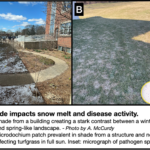
Pink snow mold is a disease caused by the fungal pathogen Microdochium nivale (syn. Monographella nivalis) that is being observed in middle and northern Indiana this late winter. The pathogen is termed psychrophilic, or cold loving, due to its propensity to grow and infect in colder temperatures. The disease can be particularly severe on unfrozen…Read more about A Cold Mold that Craves the Shade[Read More]


Look Below Before Blaming Above

Recently, home lawns have been maligned in several media outlets as a waste of time and resources. Mismanagement by using too much water or misplacing fertilizer may compound the issue by straining environmental resources or serving as pollutants. While not going into all the defenses for turfgrass use on home lawns, (remember “right plant, right…Read more about Look Below Before Blaming Above[Read More]

 Categories: