Category: Insect Control

Armyworms Are Poised For Battle

We have been monitoring reports of very large infestations of armyworm moths flying into Kentucky this spring.  Armyworms move north with storms from the southern states each year and depending upon how and where the storms blow will dictate when and how many moths we have to deal with.  Fortunately, in Indiana we have not…Read more about Armyworms Are Poised For Battle[Read More]

Early Japanese Beetles

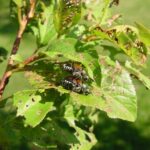
It seems that the Japanese beetles have been arriving early for the last few years but this year is truly an exception. The first Japanese beetles of the year were observed in central Indiana on the 3rd of June. This is a full week earlier than we have EVER seen them here before. Normally, Japanese…Read more about Early Japanese Beetles[Read More]


Early billbug activity

It appears that our unseasonably warm spring has pushed the activity of many insects as much as 2-3 weeks ahead of traditional expectations. Among the turfgrass insects that are showing up early this year are the billbugs. These insects over-winter as adult weevils and become active in the spring when soil temperatures reach about 50°F,…Read more about Early billbug activity[Read More]


A New Threat to Indiana Turfgrass: Two Species of Invasive Scarab Beetles (White grubs) Found in Northern Indiana

It was just a matter of time. While invasive species such as the emerald ash borer have been garnering so much attention in the press, the Turfgrass Entomology and Applied Ecology Laboratory at Purdue University has been tracking the spread of three additional species of invasive, turfgrass infesting white grubs (European chafer, Asiatic garden beetle…Read more about A New Threat to Indiana Turfgrass: Two Species of Invasive Scarab Beetles (White grubs) Found in Northern Indiana[Read More]


Earthworms Activity in Lawns

Earthworm activity is on the rise as soils warm up, but their mounds will be highly visible until grass starts growing in late March and April. Earthworms are highly beneficial because they create channels for air and water penetration, reduce thatch, and tend to increase the fertility and health of a soil. However, some will…Read more about Earthworms Activity in Lawns[Read More]


More on Nematodes and Indiana Greens

As our nematode survey continues, more questions are being asked about nematodes, their damage potential, etc. Following is an update on the survey:  Do not attribute all vague symptoms to nematodes. Nematode populations and symptoms are extremely complex and cannot be diagnosed by anyone other than a nematologist. In other words, don’t panic. …Read more about More on Nematodes and Indiana Greens[Read More]


First Black Cutworms of the Year Found in Traps

Recent storms have generated the weather patterns that bring black cutworm moths into our state each year. Pheromone traps picked up the first black cutworm moths of the season during the past two weeks. Predictive models estimate that the first cutworm caterpillars will begin feeding 300 heat units after the first moths are caught. Unseasonably…Read more about First Black Cutworms of the Year Found in Traps[Read More]


Japanese Beetles are in Full Force

The first Japanese beetles of the year were observed in central Indiana on June 22 and have since come out in full force. They are being reported in large numbers from many places throughout the state feeding on their favorite plants. Plants particularly at risk include those that have been recently transplanted or those that…Read more about Japanese Beetles are in Full Force[Read More]


Update on Black Cutworm

Significant weather events from the south usually are responsible for the movement of the black cutworm moths into our area each spring beginning as early as March. Black light traps stationed throughout the state have failed to catch many black cutworms this year to date. This is good news for our industry and may spell…Read more about Update on Black Cutworm[Read More]


News about Japanese beetles is mostly bad!

Japanese beetles are back! They appeared 10 days to 2 weeks earlier than normal this year and indications are pointing to a very heavy population in many parts of the state. Last years weather conditions kept soils moist which apparently led to a very successful grub hatch. Early emergence usually points to a somewhat earlier…Read more about News about Japanese beetles is mostly bad![Read More]


Page last modified: May 15, 2019

Turfgrass Science at Purdue University - Horticulture & Landscape Architecture, 625 Agriculture Mall, West Lafayette, IN 47907

© 2026 Purdue UniversityAn equal access/equal opportunity universityCopyright ComplaintsMaintained by Turfgrass Science at Purdue University

If you have trouble accessing this page because of a disability, please contact Turfgrass Science at Purdue University at kkalbaug@purdue.eduAccessibility Resources