May temperatures mild before summer heat, Pythium root diseases on bentgrass greens and young fairways, curative options for dollar spot that may have slipped through, wet spring can lead to issues all summer long.
*A primary objective of the Purdue Turfgrass Pathology Program is training the next generation of turfgrass professionals. This edition is co-authored with Dr. Krishna Ghimire, a post doctoral associate in our program. Giving emerging scientists real-world experience in communicating timely field observations is an important part of preparing them for future roles. Thank you for your assistance Krishna.*
Weather
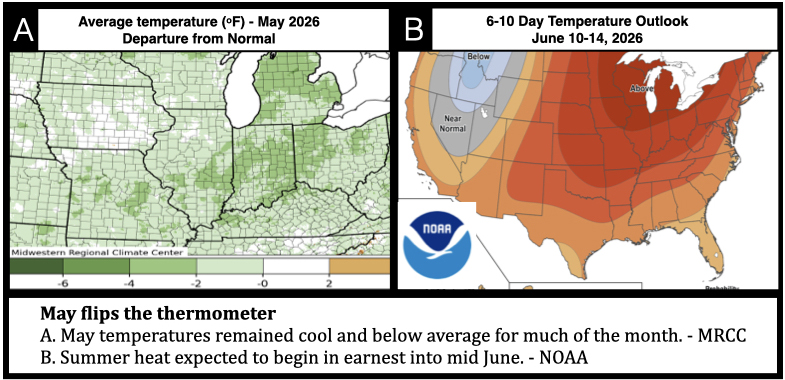
May 2026 provided favorable growing temperatures for cool-season turfgrass across much of region. Cooler than normal temperatures pervaded for much of the month, providing nighttime temperatures that mostly stayed in the 50s. Across Indiana, average May temperatures were approximately 2 to 6°F below the 1991–2020 climatological normal. After a warmer than normal April, spring temperatures have promoted steady cool-season turfgrass growth while minimizing heat stress, allowing turfgrass to maintain good color and density. Flipping the season in the quote, however “summer is coming”. Summer heat is set to arrive in full force by mid-June, coinciding with our peak photoperiod length of the year on June 20 (15 h and 2 minutes in Indy). The next few weeks will begin the test of how well prepared turfgrass health and root systems are prior to entering the summer cauldron.
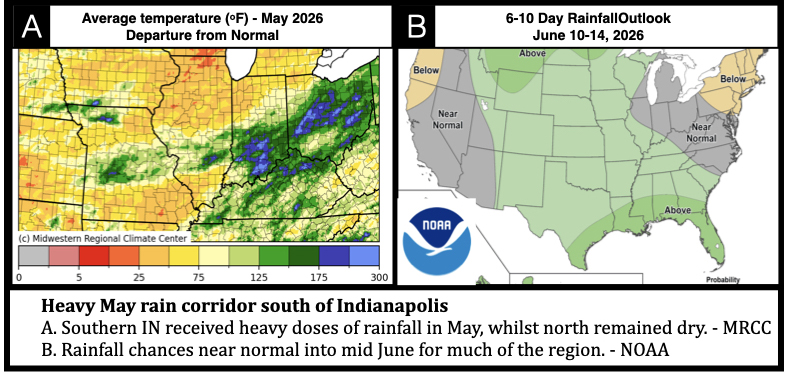
While May was mild on the temperature front, the intensity of rainfall events across the region were vibrantly dissimilar. Buoyed by a 144-year Indy rainfall record broken on Cinco de Mayo 2026 (1.92”) and another intense rainfall event May 18-20, May rainfall totals across a swath of Indiana from 1-70 southward into Kentucky (including Bloomington and Columbus) were 2 to nearly 6” above normal for the month. Conversely, Indiana’s southwestern tip into Carbondale, IL and through Cape Girardeau, MO were exceedingly dry, along with much of central Illinois, Chicago, and northern Indiana (Drought Monitor – Midwest). Storms sparked by a cold front are likely this weekend, followed by a span of speculative chances for precipitation through mid-June.
Golf: Pythium root diseases showing teeth
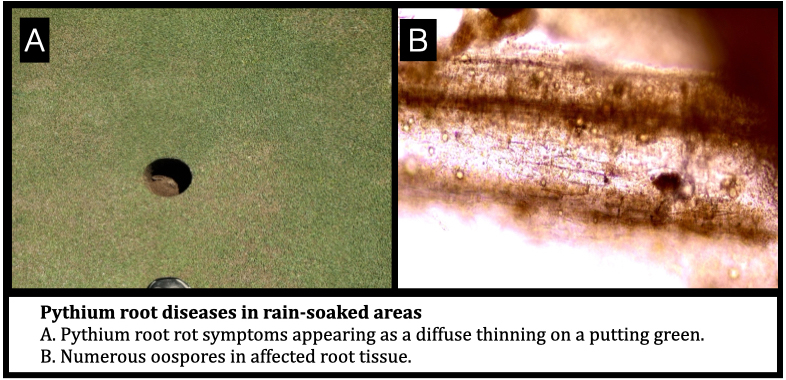
The combination of frequent rainfall and saturated soils has resulted in the first few samples of Pythium root diseases to enter the diagnostic lab. In mid-May, the Purdue Plant and Pest Diagnostic Laboratory received a bentgrass putting green sample from mid-Missouri exhibiting turf decline, chlorosis, and thinning. Microscopic examination of infected roots revealed numerous oospores of Pythium species. These thick-walled survival structures are characteristic of Pythium root infections and confirm that the pathogen was actively colonizing root tissues. More recently, bentgrass samples from southern Indiana from fairways were submitted to the lab with similar symptoms and abundant Pythium infection in roots and crowns. The common denominator is the swath of blues and greens shown in previous figure indicating several strong bursts of May rainfall.
Pythium root rot is associated with excessive soil moisture, poor drainage, and prolonged periods of root-zone saturation. When oxygen levels in the soil decline due to waterlogged conditions, turfgrass roots become stressed and more susceptible to infection. In addition, Pythium is a water mold and soil inhabiting species have this skill of producing sporangia quickly in waterlogged conditions. In as little as 1-4 hours, these sporangia rapidly mature to produce motile zoospores, which take advantage of the water highways to spread to new areas. If a plant pathogenic Pythium spp. that new nesting spot is another healthy root. As these cycles repeat, more roots are infected and symptoms express quickly when warm temperatures or other stresses occur.
Young bentgrass plantings are more susceptible to Pythium infection. Pythium root dysfunction, a different disease than Pythium root rot, is notoriously more prominent on younger bentgrass greens. In our microscopic observations on seedlings, we often see a mix of oospore types indicating species that cause Pythium root and Pythium root dysfunction don’t mind infecting the same root tissue and work in cahoots to take down the plant. Interestingly, some of my turf pathology colleagues and I are noticing Pythium root infection on fairways as well as greens. Curative applications of cyazofamid or picarbutrazox are suggested for symptomatic greens, but on larger fairway acreages these applications can get cost prohibitive. A potential preventive measure could be to start phosphite applications earlier, which are used commonly to prevent Pythium blight outbreaks on established bentgrass fairways. More research is needed to determine the amount of “nutrient phosphorus” needed to overcome any possible limitation in root uptake invoked from phosphites and the timing of these two potential rivals in the seeding process.
As summer approaches, superintendents should closely monitor root health in areas that remain wet for extended periods. Find out if what areas drain sufficiently and which hold water. Vent greens regularly, particularly after another one of these grand rain events that can leave older, organic matter heavy greens oversaturated. When fungicides are used to prevent or suppress Pythium root diseases (or fairy ring, take-all patch and/or summer patch) products should be applied with sufficient post-application irrigation to move the active ingredient into the root zone where infection occurs.
ALL: When dollar spot slips through the five-hole
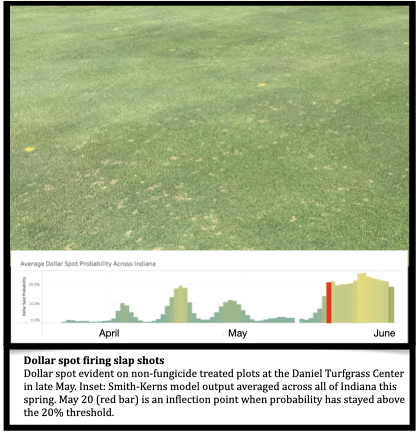
The Smith-Kerns dollar spot prediction model as shown in the Purdue Turf Disease Prediction Tool indicated an average period of moderate to high risk (above 20%) starting on May 20 in Indiana and not letting up since. Dollar spot symptoms summarily started developing quickly in late May and spread throughout our most susceptible ‘Crenshaw’ and annual bluegrass putting green plots. Symptoms have not developed yet on our fairway plots on native soils, which potentially have more plant available nitrogen or antagonistic microbial activity to stave off this first period of disease pressure.
When high risk first occurs or is forecasted, preventive fungicide applications are warranted on greens, tees and fairways intended to be disease free. Most fungicides work best applied prior to symptom development when inoculum levels are low and symptom recovery isn’t also needed during the application window. Some may wait to make early curative applications on fairways or tees (particularly if planted with a modern resistant cultivar), perhaps using a rare patch of Poa trivialis as an indicator. At this point, some may also need to recover from application skips or unintended gaps between application intervals. In these cases, applications of fungicides that either take longer to take effect (i.e. boscalid and some DMIs) or need a shorter application interval (i.e. fluazinam) may not result in quick recovery. More of our evaluation trials have a primary focus on curative activity and in these trials effective SDHI fungicides such as fluxapyroxad (Xzemplar) and pydiflumetofen (Posterity).
Dollar spot outbreaks on Kentucky bluegrass lawns were prevalent last season and should be expected again this year. Integration of sound cultural practices, including balanced fertility, dew removal, appropriate mowing frequency and height and judicious irrigation management, provides an environmentally sound management approach. Preventive fungicide programs on these lawns may not be necessary if these practices are implemented and the disease is caught early and identified properly (see BP-218-W). In severe cases, fluxapyroxad which is labeled for residential use along with a small shot of nitrogen fertilizer (0.25 lb N/1000 sq ft) can encourage rapid recovery.
LAWN: Wet feet in spring can mean a tough summer
No one likes wet feet and prolonged wet toes can cause ugly conditions such as athlete’s foot, blisters, or trench foot. The abundant rainfall that occurred this spring in southern IN raises some concern for trenched roots in lawns. Saturated soils reduce oxygen availability in the root zone, limiting root growth and function even when turf appears healthy aboveground. If warm temperatures quickly arrive even after soils dry out, turf can quickly transition from vigorous growth to decline since the depth of the root system has been restricted. In many situations, the effects of spring root stress are not fully realized until the first extended periods of summer heat. As summer approaches, careful irrigation management, attention to drainage, and monitoring of root health will be critical to quality turf maintenance.
This bears repeating from the April 2026 report and a follow up article in the Purdue Landscape Report. A common mistake in home lawn management is continuing automatic irrigation schedules despite frequent rainfall. Unlike golf course putting greens, most home lawns are established on heavier native soils that retain moisture for longer periods. Additional irrigation may unnecessarily prolong soil saturation and increase leaf wetness, creating favorable conditions for foliar diseases while limiting important spring root growth. Homeowners should regularly evaluate soil moisture before irrigating and adjust controllers to reflect current weather conditions rather than relying on fixed schedules. Poorly drained areas of lawns may also begin to reveal populations of nutsedges or rough bluegrass (Poa trivialis) as they outcompete desirable grass in these conditions. Rough bluegrass submissions for identification in the PPDL have become increasingly common. This weed, which is a common contaminant in seed, often thrives during cool, wet spring conditions but struggles during summer heat. As temperatures rise, affected areas may appear yellow, thin, or drought stressed, creating irregular patches that are frequently mistaken for disease. For more information on rough bluegrass see Dr. Aaron Patton’s description here or even better pick up the guide Turfgrass Weed Control for Professionals here.
Purdue Turfgrass and Landscape Field Day – Tuesday, July 21st (Register Here)
The agenda is out and can be seen below. We have a ton of great information lined up that cover all gamuts of the turfgrass industry. For golf, we’ll be talking about autonomous mowing, new disease resistant varieties, and maximizing fungicide impact. Lawn improvement practices, nitrogen fertilization, weed control, logos and line painting for sports fields, and various other topics are on tap. Hope you can find the time to join us.

Lee Miller
Extension Turfgrass Pathologist – Purdue University
Follow on Twitter: @purdueturfpath
Follow on LinkedIn: @purdueturfpath