May 4, 2026: Spring Hits the Brakes

May 2026 hits the brakes on spring; root infection observed on putting greens by soilborne pathogens; constant spring rains = surprise black layer; delayed (or no) spring green up on lawns is not always disease.
*An objective of the Purdue Turfgrass Pathology Program is training the next generation of turfgrass professionals. This edition is co-authored with Justice Ruwona, a PhD candidate in our program. Giving emerging scientists real-world experience in communicating timely field observations is an important part of preparing them for future roles. Thank you for your assistance Justice.*
Weather
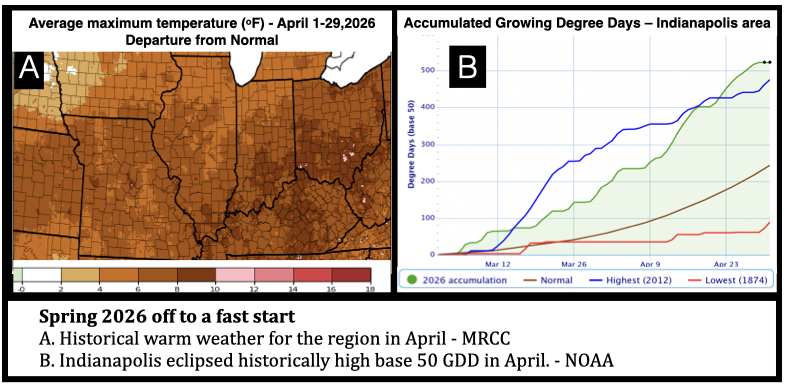
Happy May to and May 4th to my fellow Indy 500 and Star Wars fans. The light sabers were hot in April 2026, with spring heat continuing from March and accelerating the start of the growing season. Above‑normal warm temperatures, including several days over 80°F, pushed early green‑up and rapid growth well ahead of schedule. Much of the state finished the month 6-10°F above normal. The Indianapolis area recorded the highest spring growing degree day accumulation in recorded weather history, surpassing the fast start previously observed in 2012. These conditions translated into fast growth, earlier mowing, and excess leaf clippings than typically observed in April. If it feels like we are nearly a month ahead of schedule, it’s because we are.
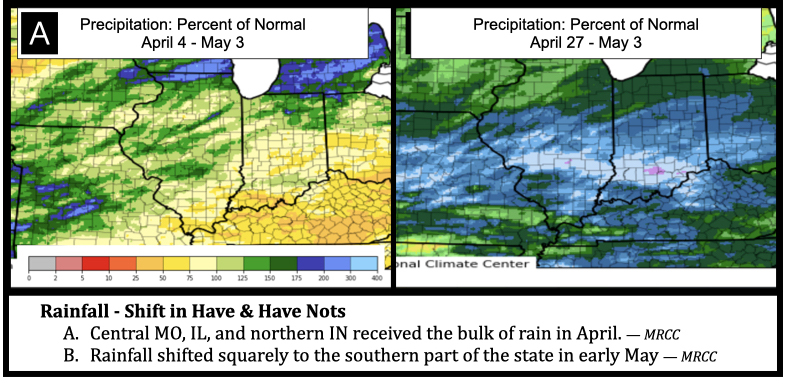
Rainfall during April was highly variable. Strong storm systems early in the month delivered heavy downpours and localized flooding, with locations in central MO, central IL and northeast IN approaching or exceeding normal monthly totals of 3.5–4.5 inches from just a few rain events. Conditions were drier for much of April in central Indiana and along the Ohio River Valley which was welcome compared to the previous deluge of rainfall last spring in the region. More recently, (including today), a distinct shift in rainfall transitioned towards central and southern IN. On April 27, severe thunderstorms passed through central Indiana and produced 1.61 inches of daily rainfall in Indianapolis, breaking the previous record of 1.56 inches set in 2002.

Following rapid early‑season growth, cooler weather has returned and slowed turf development. Forecasts call for a cooler‑than‑normal start to May, with daytime highs often below seasonal averages and overnight lows dipping into the 40s. At the time of writing, a freeze watch is in effect for portions of northern Indiana. Soil temperatures beneath established sod have reached or are above 60°F across much of the state, and a little slow down of cool season growth may be welcome. Warm season turfgrasses in southern IN will slow considerably and with the high amount of rain expected, large patch and other disease activity should be monitored. April showers are not expected to go away in May, with heavy rainfall events likely disrupting mowing and other maintenance practices.
GOLF: Look down below
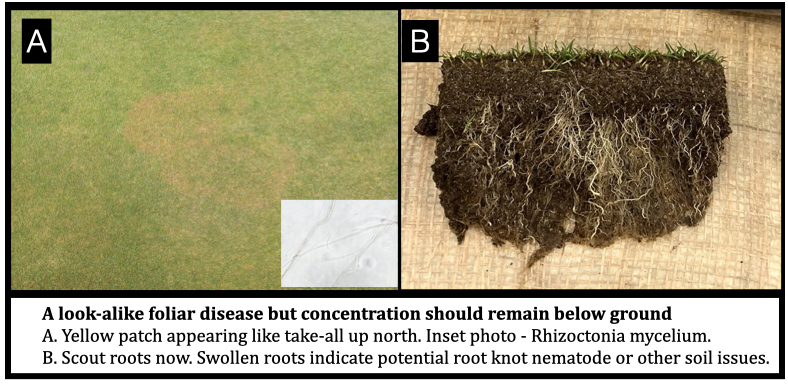
With the cooler temps, dollar spot pressure lowered over the past week with average dollar spot probability across Indiana being less than 10% in the first days of May. Prolonged leaf wetness from rainfall/irrigation combined with warming temperatures could quickly alter disease activity. One foliar disease with symptoms fooling us in April was yellow patch caused by Rhizoctonia cerealis. At a course in north central Indiana, which has been riddled with frequent rain events, this disease was prominent on several fairways. The superintendent was concerned with an early outbreak of take-all patch symptoms which as a soilborne disease is more difficult to control and recover from. Fortunately, damage from yellow patch is normally minor, but in more severe cases such as this one recovery can be hastened with a foliar application of azoxystrobin, propiconazole or tebuconazole.
Despite this anomaly, superintendents should still keep focus on their root assets below ground. Sample submissions to the diagnostic lab have begun to increase, and without a correlation to plant symptoms, roots are showing signs of infection and pathogen presence. A recent sample from a green had summer patch issues last season showed signs of multiple soilborne pathogens in the roots, including summer patch, take-all patch and Pythium root disease. Patch diseases present diagnostic challenges because they often occur simultaneously, and several produce similar runner hyphae on infected roots under microscopic examination. Fungicide applications do not eliminate these pathogens from the soil profile, and disease recurrence should be expected on historically affected sites.
Heavy rainfall events and sporadic soil saturation in spring delivers a two-fold advantage to root-invading pathogens. Free moisture is needed for infection and for Pythium root diseases, saturated soils cause the quick formation of sporangia and resulting motile swimming zoospores that disseminate the pathogen to other roots. Saturated conditions also impede root function, by replacing air and inhibiting root respiration.
This late spring is a great time to physically investigate root quality on putting greens. A 0.75” soil corer serves well to examine a portion of the roots and quality of the soil profile down to the pea gravel. The flat profile from a Mascaro soil sampler gives a better representation of root quality, and using water to rinse off excess sand is best to visualize root color and quality. In the above photo, a profile revealed white roots that were swollen towards the bottom root tips. This can be an indicator of infection by root knot nematodes or the impact of a root pruning preemergence herbicide. Additionally, darker colored brown root symptoms can provide clues to pathogen infection.
Note the density of thatch in the above photo from 30+ old greens and realize the difficulty of delivering a fungicide through that layer. Even younger bentgrass greens with newer dense cultivars and especially ultradwarf bermudagrass greens have a thatch layer that ties and binds fungicides readily, so getting preventive fungicides through this section and to the roots below is difficult. If struggling with soilborne diseases, take a hard look at the profile and plan on using heavy amounts (0.2-025” or more) of post-application irrigation to facilitate fungicide penetration.
Black layer in April
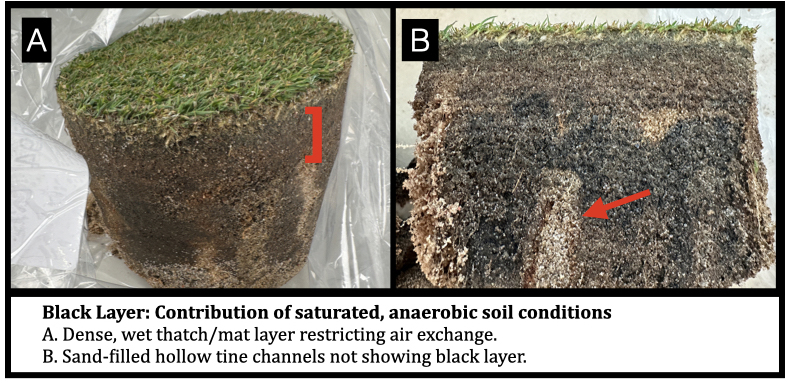
A creeping bentgrass sample from northern Indiana was submitted to the diagnostic lab in April showing symptoms consistent with black layer, an abiotic disorder caused by anaerobic soil conditions and sulfur‑reducing bacteria (Desulfovibrio spp.). These bacteria produce hydrogen sulfide gas, which is toxic to turf roots. While black layer is more commonly observed during midsummer, its appearance this early highlights the impact of prolonged soil saturation this spring.
Fungicides are ineffective against black layer. Management should instead focus on increasing soil oxygen through aeration, improving drainage, and avoiding practices that prolong excessive moisture. Fertility programs should also be reviewed, with consideration given to temporarily reducing sulfur‑ or sulfate‑containing products where symptoms persist.
LAWN: Delayed spring green-up in cool season lawns not always disease
Kentucky bluegrass samples submitted in late March raised concerns about uneven or delayed spring green‑up; however, in most cases, the underlying cause was not disease. Many newer Kentucky bluegrass cultivars are selected for improved summer performance and disease resistance, often at the expense of rapid spring green‑up. Differences in cultivar genetics, soil fertility, and site conditions can temporarily exaggerate uneven color in early spring.
As we move further into May, lawns that remain completely dormant likely experienced winter or environmental injury. Common causes include snowplow damage, salt accumulation near sidewalks and roads, buried debris, or shallow soils. On several campus areas where salt‑laden snow piles persisted, turf has not recovered and will require reseeding. In addition, crabgrass was extremely invasive and prevalent on home lawns last summer. Warm season annuals like crabgrass die off in the winter and leave an open exposed area for winter annuals like common chickweed to infiltrate.
Understanding the difference between delayed growth and true disease activity can help lawn managers avoid unnecessary inputs and focus on practices that support recovery. For actively growing cool‑season lawns, a light to moderate nitrogen application in May can help increase density and vigor ahead of summer stress.
Information on how wet springs influence excessive clippings, seedheads and lawn health, is available in the May 2025 disease report here.
Additional notes
Over the winter, I created this online module Turfgrass IPM Module – Understanding Turfgrass Fungicides course to allow you to earn CCH education credits (with six additional states also given approval). This education is delivered in a creative, modern format and covers the basics in understanding the form and function of turfgrass fungicides and how they should be considered when implementing into a program.
SAVE THE DATE: Purdue Turfgrass and Landscape Field Day – Tuesday, July 21st
Lee Miller
Extension Turfgrass Pathologist – Purdue University
Follow on Twitter: @purdueturfpath
Follow on LinkedIn: @purdueturfpath