Category: Establishing a Turf Area

How much perennial ryegrass/Kentucky bluegrass in a mix?

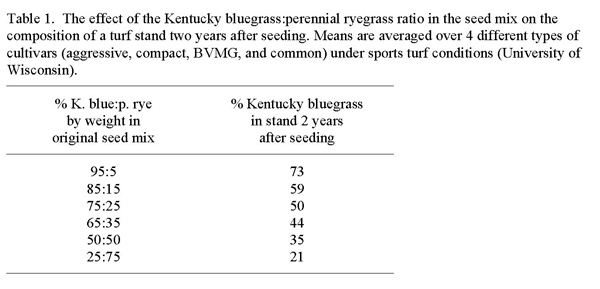
With the renovation season here, questions abound about how much perennial ryegrass to use in a P. rye/K. bluegrass mix. Perennial ryegrass germinates quickly and provides quick cover and soil stabilization when used in a blend. However, too much perennial ryegrass leads to long-term problems from dollar spot, brown patch, red thread, and other diseases….Read more about How much perennial ryegrass/Kentucky bluegrass in a mix?[Read More]


Using clover for lawns?????

Recently I was contacted by a major newspaper reporter who was writing an article about more sustainable lawn systems, or lawns that would required fewer inputs, and was inquiring about the feasibility of  using clover as a lawn turf. After a brief head-scratching and a few questions about his intent we had a nice conversation…Read more about Using clover for lawns?????[Read More]


Seeding into areas where preemergence herbicide was applied this spring

A fairly typical question now is, ”Can I seed into an area where preemergence herbicide was applied earlier this spring”. The answer is a very simple “No”. These herbicides are active in the soil for up to 120 days and their nature is to be absorbed into the root of a germinating weed (or turfgrass…Read more about Seeding into areas where preemergence herbicide was applied this spring[Read More]


Seeded bermudagrass or zoysiagrass is an option for some IN turf areas

In the southern third to of Indiana, seeded zoysia is a viable option for golf course fairway and tees, whereas seeded bermudagrass is an option for golf course fairways and athletic fields. A tremendous amount of recent research has been done on both of these species at Purdue as well as other universities. Our former…Read more about Seeded bermudagrass or zoysiagrass is an option for some IN turf areas[Read More]


Time is running out for spring seeding

As lawns are greening up, many calls are coming in about damage left over from last summer or perhaps even winter damage. Unfortunately, spring seeding is difficult at best because of pending hot weather and/or weed and disease pressure. Late summer (August) is easily the best time to seed cool-season grasses, but sometimes turf must…Read more about Time is running out for spring seeding[Read More]


Do it yourself: Searching for that low maintenance lawn?

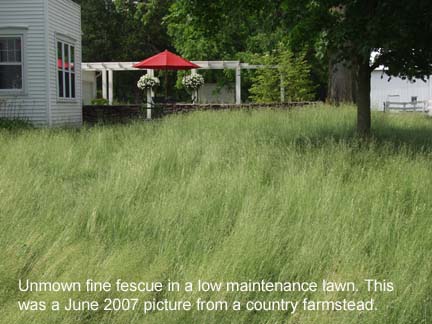
We get a ton of calls and email inquiring about low maintenance lawns. Simply put, there are no silver bullet grass species that are low maintenance and will also survive summers and winters in IN. That being said, hiring professionals to mow and maintain your lawn is the best method for reducing your input. Following…Read more about Do it yourself: Searching for that low maintenance lawn?[Read More]


How late can you seed?

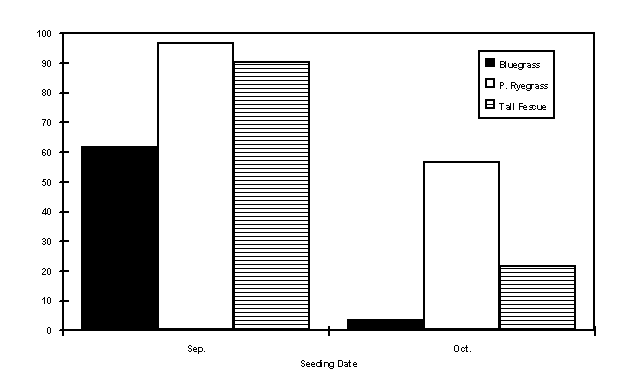
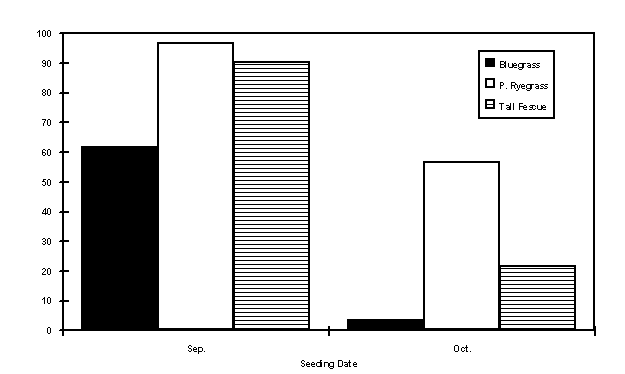
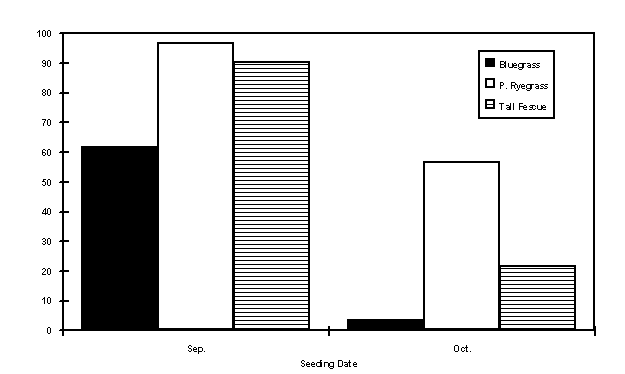
We are out of the optimum window for seeding turfgrasses in Indiana. However, many are still hoping to seed. Following is a summary of our studies in the early 90’s on seeding at less than optimum times of the year. For optimum establishment, seeding should be done in late August or early September.  Waiting as…Read more about How late can you seed?[Read More]


Rejuvenating Turf Areas After Drought

Eight weeks or more of high temperatures with minimal rain has taken a toll on turfgrasses around the state. Though some local areas in central IN have received ample rain in the last week, many areas are still very dry. We are just entering the window when significant turf recovery can be encouraged. Reseeding is…Read more about Rejuvenating Turf Areas After Drought[Read More]


How much perennial ryegrass Kentucky bluegrass in a mix?

With the renovation season fast-approaching, questions abound about how much perennial ryegrass to use in a P. rye/K. bluegrass mix. Perennial ryegrass germinates quickly and provides quick cover and soil stabilization when used in a blend. However, too much perennial ryegrass leads to long-term problems from dollar spot, brown patch, red thread, and other diseases….Read more about How much perennial ryegrass Kentucky bluegrass in a mix?[Read More]


Sand Topdressing Programs

There are many different sand topdressing programs used by superintendents. Budgets, experience, labor and equipment availability, and play schedule are just some of the factors affecting topdressing programs. Our research hopes to provide answers to many of the common topdressing questions and help present a better understanding of the topdressing requirements for high quality putting…Read more about Sand Topdressing Programs[Read More]


Managing Surface Organic Matter in Bentgrass Putting Greens

As you begin planning for spring core cultivation, consider the following as some food for thought. Turf research has shown that excessive organic matter, and/or thatch (> ½ inch), in the upper (1-2 inches) rootzone profile can lead to rapid turf decline during stressful summer months. Excessive organic matter results in low soil oxygen, poor/shallow…Read more about Managing Surface Organic Matter in Bentgrass Putting Greens[Read More]


If You Must Seed, Do it Now

Late summer (August) is easily the best time to seed cool-season grasses, but sometimes turf must be seeded in the spring. The following points should help improve the success of spring seeding: 1. Seed as soon as possible (now is not too early) so the seed is in the ground and ready to germinate as…Read more about If You Must Seed, Do it Now[Read More]


How late can you seed?

We are out of the optimum window for seeding turfgrasses in Indiana. However, many are still hoping to seed. Following is a summary of our studies in the early 90’s on seeding at less than optimum times of the year.  For optimum establishment, seeding should be done in late August or early September. Waiting…Read more about How late can you seed?[Read More]


Why New Lawns Fail?

It is increasingly common for newly-established lawns to thin or completely fail within a year. There are many reasons for this to occur but here are my top ten: 1. Poor soil – heavy clay in today’s subdivisions is not conducive for quality turf, so good soil preparation is required, see number 3. 2. Poor…Read more about Why New Lawns Fail?[Read More]


Now is the Time to Seed Cool-Season Turf

Late summer is the best time to establish Kentucky bluegrass, creeping bentgrass, tall fescue, and perennial ryegrass from seed. Between August 15 and September 15 is optimum seeding time in the northern half of Indiana, from September 1 to September 30 is optimum in the southern half of Indiana. It is critical to seed as…Read more about Now is the Time to Seed Cool-Season Turf[Read More]


Considering Artificial Turf For Sports Fields?

Tremendous improvement in the artificial turfs has renewed interest in these turfs for sports fields. The decision to use artificial turf is difficult because these fields are a huge investment to install, maintain, and eventually replace. This technology is relatively new and still evolving, and thus questions abound on performance, safety, injury, maintenance costs, lifespan,…Read more about Considering Artificial Turf For Sports Fields?[Read More]


Turfgrass Does not Perform Well in the Shade (Period)

We have received a ton of calls in the last week about improving shaded lawns. Following is a summary about shaded lawns:  Turf does not perform well in the shade  “Shade-adapted“ grass species and cultivars will always perform better in full sun compared to shade (regardless of what the label states)  As…Read more about Turfgrass Does not Perform Well in the Shade (Period)[Read More]


How late can you seed?

We are out of the optimum window for seeding turfgrasses in Indiana. However, many are still hoping to seed. Following is a summary of our studies in the early 90’s on seeding at less than optimum times of the year. For optimum establishment, seeding should be done in late August or early September. Waiting as…Read more about How late can you seed?[Read More]


Time is Running Out to Seed Your Lawn

It now almost too late to seed this fall to expect the seedlings to form a good stand before winter, especially with the dry conditions that remain in the forecast. The optimum time to seed cool-season turfgrasses is between Aug. 15 and Sept. 15 in central IN, a week earlier in northern IN, and a…Read more about Time is Running Out to Seed Your Lawn[Read More]


Turf 101: Optimum temperatures for seed germination

We’ve just entered the optimum seeding window for cool-season grasses throughout the state of Indiana. Though seed will germinate at a wide variety of temperatures, the optimum temperatures for germination are in the table below. The temperatures listed are air temperatures which would be almost identical to that in on the surface of the soil…Read more about Turf 101: Optimum temperatures for seed germination[Read More]


Page last modified: May 20, 2019

Turfgrass Science at Purdue University - Horticulture & Landscape Architecture, 625 Agriculture Mall, West Lafayette, IN 47907

© 2026 Purdue UniversityAn equal access/equal opportunity universityCopyright ComplaintsMaintained by Turfgrass Science at Purdue University

If you have trouble accessing this page because of a disability, please contact Turfgrass Science at Purdue University at kkalbaug@purdue.eduAccessibility Resources