Tag: Turf Professional

MRTF Golf Day at The Fort in Indianapolis on September 30

Openings are still available for the MRTF Golf Day at The Fort Golf Resort in Indianapolis on September 30. This annual event is held to promote turfgrasss research, raise awareness of the Purdue Turfgrass Science Program, and provide an enjoyable...
Read More
Tall fescue for Indiana lawns but not most sports fields

Tall fescue is a great turf for lawns throughout most of Indiana. It requires about ½ the nitrogen and far less irrigation than Kentucky bluegrass when managed for the same aesthetic appearance. Because of its deeper rooting and access to...
Read More

How much perennial ryegrass/Kentucky bluegrass in a mix?

With the renovation season here, questions abound about how much perennial ryegrass to use in a P. rye/K. bluegrass mix. Perennial ryegrass germinates quickly and provides quick cover and soil stabilization when used in a blend. However, too much perennial...
Read More

For professionals: Avoid late summer weed control

Though this summer has been pretty kind for our cool-season grasses, a number of weeds may be at high enough populations to become problematic. With temperatures forecast in the high 80’s or 90’s for the next week, it is probably...
Read More

Dollar Spot

Dollar spot is caused by a fungal pathogen, Sclerotinia homoeocarpa, that blights leaf tissues but does not affect turfgrass roots or crowns. The disease is a common concern on golf course turf, especially creeping bentgrass and annual bluegrass greens, tees, and...
Read More

Rust Diseases

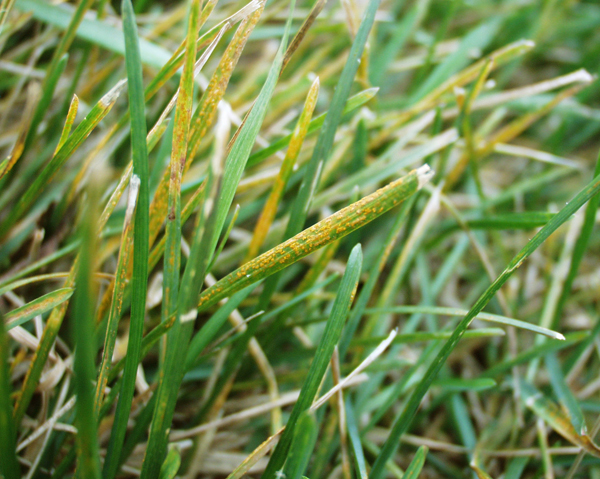
Rust is a disease of taller mown turf. Outbreaks are most common on residential lawns, low budget athletic fields, and, occasionally, on golf course roughs. A variety of related fungi cause rust. Ccommon names include leaf rust, crown rust, and...
Read More

Professionals only: Rust/dollar spot thriving in lawns

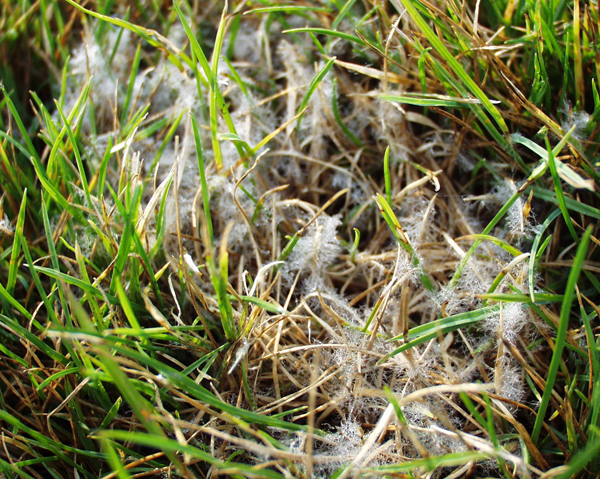
The diseases rust and dollar spot are thriving in Indiana lawns right now, which is fairly typical for this time of the year. These are both low nitrogen diseases, so are almost inevitable as we try to keep lawns on...
Read More

Cicada killers: A Nuisance or a Danger?

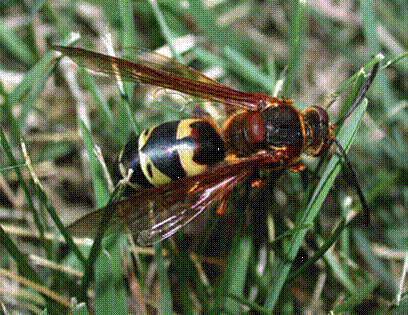
A number of solitary bees and wasps reside in turfgrass and landscapes. Because of their ability to harm humans, these insects often evoke a great deal of anxiety. However, in reality they very rarely sting. Education is the single best...
Read More

Reminder: New golf course pesticide rule went into effect August 1, 2009

The Indiana State Chemists Office's (ISCO) new pesticide rule went into effect Aug. 1 and includes: Any person applying any pesticide to a golf course must have a commercial pesticide applicator license or be under the direct supervision of a...
Read More

Securing The Load

Losing cargo on the road is serious business. The proper loading, positioning, and securing of cargo on a truck or trailer can prevent accidents in transit. This publication refers to government securement regulations and describes proper techniques for securing cargo on farm and commercial trucks and trailers.

(PPP-75)


PDF

PDF version of Securing The Load

Read More

New web registration now available for the Midwest Regional Turf Field Day on July 21

We have just unveiled our new web registration for all MRTF functions, just time for Field Day on July 21.  Registration for all events is at http://mrtf.org/php/education.php and registration for Field Day specifically is at http://mrtf.org/php/education.php#FieldDay. Some of the features of this year’s...
Read More

For professionals only: Solitare herbicide now labeled for Indiana

FMC’s Solitare 75WG received its federal and state label for Indiana in June and is should be available from your professional product distributors. Solitare is a combination of sulfentrazone (Dismiss) and quinclorac (Drive and others) and should provide control of...
Read More

Controlling ground ivy and/or violets

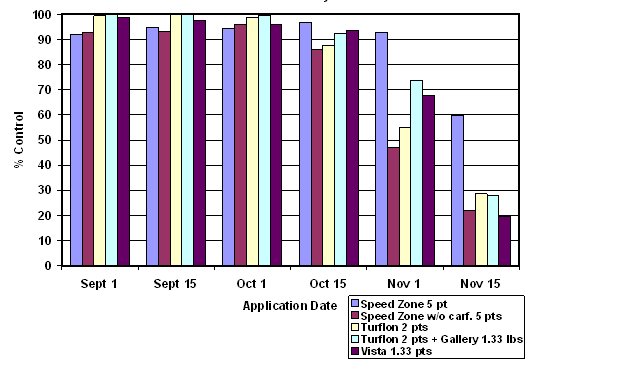
As lawns start to thin from summer heat, ground ivy and violets begin to overtake the turf especially insahded areas.  These two weeds remain tough to control in Indiana. Even though applications now can produce visible damage, long-term control does...
Read More

Patch Disease Symptoms Starting to Show in Dry Kentucky Bluegrass Lawns

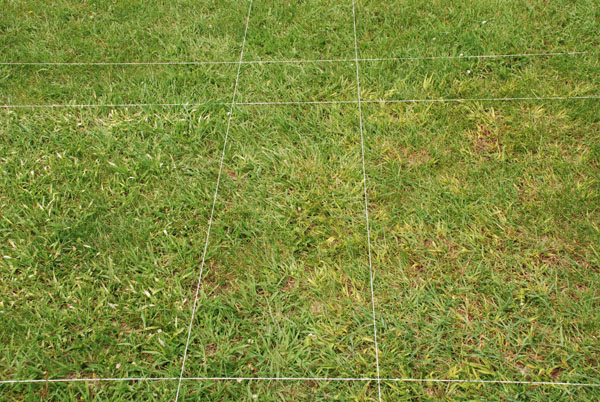
Summer patch and necrotic ring spot are root-infecting diseases in Kentucky bluegrass lawns.  Their symptoms are some of the most difficult to manage, much less control the disease. Although these diseases differ slightly in when they attack the roots, the...
Read More

Using clover for lawns?????

Recently I was contacted by a major newspaper reporter who was writing an article about more sustainable lawn systems, or lawns that would required fewer inputs, and was inquiring about the feasibility of  using clover as a lawn turf. After...
Read More

Summer Mowing and Fertilization

By the time you read these words the longest day of the year has approached and the official calendar “Summer” season will have begun. Just as the weather changes as we transition between seasons from late-Spring to Summer the turfgrass...
Read More

Reicher to join University of Nebraska in March

After 21 years at Purdue, 17 of which as the Extension Specialist, I will be leaving Purdue University. Kim and I will be moving to the University of Nebraska-Lincoln where Kim will become the Director of Landscape Architecture and Regional...
Read More

Poa annua, Poa trivialis, and/or creeping bentgrass in lawns and sports fields

Poa annua (annual bluegrass), Poa trivialis (rough bluegrass) and creeping bentgrass are becoming common weeds in athletic fields and lawns. These weeds are important to distinguish because they require different controls. Poa annua: a winter annual that is lighter, more apple green than other...
Read More

New topics and tours at the Turf Field Day on July 21

The Midwest Regional Turf Field Day that will be held on Tuesday, July 21 at the W.H. Daniel Turfgrass Research and Diagnostic Center in West Lafayette. A number of additions should make this one of the best field days yet....
Read More

Dallisgrass healthy in southern IN

Dallisgrass has reemerged and is very healthy with the rain and warming temperatures. Dallisgrass is often mistaken for crabgrass but typical preemergence or post emergence crabgrass herbicides do not work on dallisgrass. MSMA is currently the standard control but that...
Read More