Turf Professional


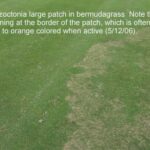
Rhizoctonia Large Patch in Bermudagrass

With the continued cool wet weather, Rhizoctonia Large Patch (RLP) is affecting bermudagrass fairways. Prior to widespread use of bermudagrass in southern Indiana and northern Kentucky, we thought RLP affected only zoysia and was thus known as zoysia patch. However, RLP caused serious thinning in bermudagrass in an occasional spring the last few years. This…Read more about Rhizoctonia Large Patch in Bermudagrass[Read More]
 Categories:

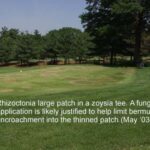
Rhizoctonia Large Patch (Zoysia Patch) in Zoysia

With the continued cool wet weather, Rhizoctonia Large Patch (RLP or zoysia patch) is in high gear. This follows a warm winter that also encouraged RLP, which is the only major disease of zoysiagrass in Indiana. Like snow mold, a rust to orange colored band on the outside of the patch indicates activity. Though best…Read more about Rhizoctonia Large Patch (Zoysia Patch) in Zoysia[Read More]

 Categories:

Nematode Damage in Golf Greens

We are suspecting more and more instances of actual nematode damage or at least secondary effects of nematodes in golf greens. Effects of nematode feeding would include yellowing, thinning, enhanced drought stress, and other symptoms reflective of a poor root system. Unfortunately, symptom expression may be enhanced or complicated by poor rooting from summer weather,…Read more about Nematode Damage in Golf Greens[Read More]


Considering Artificial Turf For Sports Fields?

Tremendous improvement in the artificial turfs has renewed interest in these turfs for sports fields. The decision to use artificial turf is difficult because these fields are a huge investment to install, maintain, and eventually replace. This technology is relatively new and still evolving, and thus questions abound on performance, safety, injury, maintenance costs, lifespan,…Read more about Considering Artificial Turf For Sports Fields?[Read More]


First Black Cutworms of the Year Found in Traps

Recent storms have generated the weather patterns that bring black cutworm moths into our state each year. Pheromone traps picked up the first black cutworm moths of the season during the past two weeks. Predictive models estimate that the first cutworm caterpillars will begin feeding 300 heat units after the first moths are caught. Unseasonably…Read more about First Black Cutworms of the Year Found in Traps[Read More]


Time is Running Out for Preemergence Control of Crabgrass

April 15-20 usually marks the end of the window for applying traditional preemergence herbicides in central IN, a week earlier in southern IN, and a week later in northern IN. Though most preemergence herbicides do have minor post-emergence properties that will burn back small crabgrass (one or two leaf stage), this is not always reliable….Read more about Time is Running Out for Preemergence Control of Crabgrass[Read More]

 Categories:

Spring Dandelion Control for Professionals

Many turf areas did not get treated for broadleaf weeds last fall because of the dry fall combined with the fairly early snowfall. Though fall applications are most effective for controlling broadleaf weeds, spring applications are warranted for new lawns or areas that did not get treated last fall. Spring applications will be most effective…Read more about Spring Dandelion Control for Professionals[Read More]

 Categories:

Mark Your Calendars: Turf Field Day moved to July 18

The Midwest Regional Turf Field Day has been moved one week earlier to July 18 at the Wm H Daniel Turfgrass Research and Diagnostic Center in West Lafayette. This is a great opportunity for turf professionals to view the latest in turfgrass research, talk to Purdue specialists about turf and ornamental issues, and visit with…Read more about Mark Your Calendars: Turf Field Day moved to July 18[Read More]

 Categories:

Attempting Ground Ivy Control

Ground ivy remains one of our toughest weeds to control. Following is our recommendation for maximizing control, based on experience and seven years of research: 1. Mow at 3” or higher. 2. Remove as much of the shade as possible. 3. Increase fertilizer up to 4.0 lbs N/1000ft2/yr fertilizing primarily in the fall 4. Make…Read more about Attempting Ground Ivy Control[Read More]

 Categories:

Turfgrass Does not Perform Well in the Shade (Period)

We have received a ton of calls in the last week about improving shaded lawns. Following is a summary about shaded lawns:  Turf does not perform well in the shade  “Shade-adapted“ grass species and cultivars will always perform better in full sun compared to shade (regardless of what the label states)  As…Read more about Turfgrass Does not Perform Well in the Shade (Period)[Read More]


March 30-31 Workshop to complete requirements for pesticide licensing (3BRT)

Are you interested in making pesticide applications to your customers’ lawns? Indiana law says anyone who wants to apply turf pesticides (and that includes weed killers, weed and feed products, insecticides, and other over-the-counter pesticides) FOR HIRE must be licensed to do so. To obtain a commercial turf pesticide applicator FOR HIRE license, you’ll have…Read more about March 30-31 Workshop to complete requirements for pesticide licensing (3BRT)[Read More]

 Categories:

Common Chickweed in New Seedlings

Common chickweed is currently dominating any fall- or dormant-seedings (including my lawn). Common chickweed is a winter annual, so it germinated last fall, grew well into December and is starting to spread with the temperatures this weekend (see accompanying photos). In established lawns, I wouldn’t recommend spraying it because it will die with the first…Read more about Common Chickweed in New Seedlings[Read More]


Spring Weed Control or Seeding?

With last year’s brutal summer and early fall, many areas are in need of reseeding. The question comes up about seeding and weed control: should the weeds be controlled first or should the seeding be done first? This seems like a simple question, but it’s fairly complex depending on the turf and weed species present…Read more about Spring Weed Control or Seeding?[Read More]

 Categories:

Herbicide Delays after Seeding

Almost all herbicides will affect turfgrass seedlings and application delays are usually needed following seeding. Following is information gleaned from available labels of most herbicides or herbicide types that would be used in Indiana. This is intended to provide a general idea of the limitations of each active ingredient, but please refer to the actual…Read more about Herbicide Delays after Seeding[Read More]

 Categories:

Timing of Preemergence Herbicides

If a preemergence herbicide is justified on a turf area, the timing of application is important. In theory, applying too early will expose the herbicide to soil microbes and processes in the soil that may break it down, allowing crabgrass to germinate during the latter part of the summer. Conversely, applying too late may miss…Read more about Timing of Preemergence Herbicides[Read More]

 Categories:

Rain Gauge Volunteers Needed for CoCoRaHS

What is CoCoRaHS? CoCoRaHS, the Community Collaborative Rain, Hail and Snow network, is a unique, non-profit, community-based, high density network of volunteers of all ages and backgrounds, who take daily measurements of rain and snow in their yards, athletic fields, or golf courses. And now, thanks to a partnership between the Indiana State Climate Office…Read more about Rain Gauge Volunteers Needed for CoCoRaHS[Read More]

 Categories:

There are still openings for the IN-IL Turfgrass Short Course

The IN-IL Turfgrass Short Course will be held in two locations in 2006, in Indianapolis on Feb. 13-16 and in Willowbrook, IL, on Feb. 27-March 2. This is an outstanding course for new and experienced turf professionals. It’s designed for turf managers with some experience and an understanding of HOW we maintain turf, and meant…Read more about There are still openings for the IN-IL Turfgrass Short Course[Read More]

 Categories:

IN-IL Turfgrass Short Course to be Offered in Indianapolis

The IN-IL Turfgrass Short Course will be held in two locations in 2006, in Indianapolis on Feb. 13-16 and in Willowbrook, IL, on Feb. 27-March 2. This is an outstanding course for new and experienced turf professionals. It’s designed for turf managers with some experience and an understanding of HOW we maintain turf, and meant…Read more about IN-IL Turfgrass Short Course to be Offered in Indianapolis[Read More]

 Categories:

Great Education/Tradeshow at the Turf Expo

The Midwest Turf Expo will be held on January 17-19, 2006 at the Indiana Convention Center in Indianapolis. An outstanding educational schedule compliments a rapidly filling tradeshow held in conjunction with the Indiana Park and Recreation Association. A GCSAA Seminar on understanding soils kicks off the Expo on Tuesday afternoon. Concurrent educational session begin on…Read more about Great Education/Tradeshow at the Turf Expo[Read More]

 Categories:

IN-IL Turfgrass Short Course to be Offered in Indianapolis

The IN-IL Turfgrass Short Course will be held in two locations in 2006, in Indianapolis on Feb. 13-16 and in Willowbrook, IL, on Feb. 27-March 2. This is an outstanding course for new and experienced turf professionals. It’s designed for turf managers with some experience and an understanding of HOW we maintain turf, and meant…Read more about IN-IL Turfgrass Short Course to be Offered in Indianapolis[Read More]

 Categories:

Page last modified: February 5, 2020

Turfgrass Science at Purdue University - Horticulture & Landscape Architecture, 625 Agriculture Mall, West Lafayette, IN 47907

© 2026 Purdue UniversityAn equal access/equal opportunity universityCopyright ComplaintsMaintained by Turfgrass Science at Purdue University

If you have trouble accessing this page because of a disability, please contact Turfgrass Science at Purdue University at kkalbaug@purdue.eduAccessibility Resources