Category: Weed Control

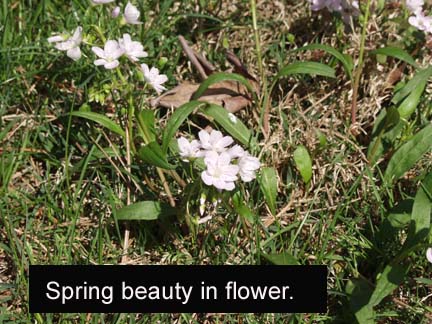
Star of Bethlehem , Spring Beauty Emerging in Shaded Areas

    Star of Bethlehem and Spring Beauty are currently emerging and flowering in shaded areas in southern and central Indiana . Both plants have pretty white flowers with the Star of Bethlehem having six petals while Spring Beauty has only five petals. The Star of Bethlehem was once planted as an ornamental while the…Read more about Star of Bethlehem , Spring Beauty Emerging in Shaded Areas[Read More]


Timing of Preemergence Herbicides: Part 2

With the above average temperatures over the last few weeks, many questions have arisen again about when to apply the preemergence herbicide for crabgrass. As mentioned in the February 20 edition of Turf Tips, it is much better to apply early rather than late. It is still not too late to apply preemergence herbicide as…Read more about Timing of Preemergence Herbicides: Part 2[Read More]

 Categories:

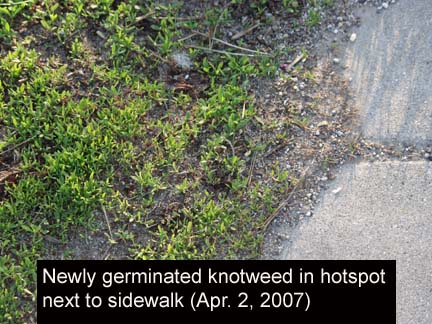
Knotweed germinating next to sidewalks and other hotspots

Prostrate knotweed is currently germinating in thin areas next to sidewalks, cart paths, driveways and other hotspots. Knotweed is often confused with crabgrass at this early stage. Knotweed leaves have rounded leaf tips whereas crabgrass has leaf tips that come to a dull point (See photos). Crabgrass also has veins running lengthwise (parallel veination) whereas…Read more about Knotweed germinating next to sidewalks and other hotspots[Read More]


Control of Quackgrass in Turf

I have received a number of calls recently about controlling quackgrass in turf. Quack is difficult to control because it spreads by deep rhizomes and herbicides do not translocate well through the rhizomes. The current best method is with 3-4 applications of glyphosate spaced 3-4 weeks apart followed by reseeding in early August. Do not…Read more about Control of Quackgrass in Turf[Read More]

 Categories:

Choose Preemergence herbicides with as Little N as Possible

If a preemergence herbicide is justified on your lawn to control crabgrass now, most of those are available combined with fertilizer and you are forced to apply a fertilizer now. Look for a product with low nitrogen and be sure the majority of the nitrogen is a slow release N. Slow release sources include sulfur-…Read more about Choose Preemergence herbicides with as Little N as Possible[Read More]

 Categories:

Choosing a Preemergence Herbicide

There are many, many formulations and combinations of preemergence herbicides available for the professional. Following are some suggestions for purchasing and using preemergence herbicides. Control from every preemergence herbicide can vary from year to year, or location to location. Therefore, you can’t judge the performance of a product or a specific rate of that product…Read more about Choosing a Preemergence Herbicide[Read More]

 Categories:

Timing of Preemergence Herbicides

If a preemergence herbicide is justified on a turf area, the timing of application is important. In theory, applying too early will expose the herbicide to soil microbes and processes in the soil that may break it down, allowing crabgrass to germinate during the latter part of the summer. Conversely, applying too late may miss…Read more about Timing of Preemergence Herbicides[Read More]

 Categories:

How Late is Too Late to Control Dandelions and Other Weeds?

With the incessant rain and high winds, most applications of broadleaf herbicides have been delayed. The good news is its not too late to apply. Nebraska research reported in 2002 showed 2,4-D and/or dicamba were far more effective in controlling dandelions and Canada thistle when applied 1 to 10 days after the first fall frost…Read more about How Late is Too Late to Control Dandelions and Other Weeds?[Read More]

 Categories:

Broadleaf Control Improves Later in Fall

We found that herbicides applied from October 1 through November 1 improved long-term ground ivy control compared to the same herbicides applied in September. Our speculation is that weeds are killed either directly by the herbicide when applied later in the fall or weakened to the point that they succumb to winterkill. Herbicides applied earlier…Read more about Broadleaf Control Improves Later in Fall[Read More]

 Categories:

Open Season on Dandelions, Clover, and Other Broadleaf Weeds

Those dandelions, clover, and other broadleaf weeds that were a problem all summer should be controlled this fall. The period from late September through all of October is the ideal time to control broadleaf weeds in turfgrass because broadleaf weeds are most susceptible to herbicides at this time. The turf and weeds must be green…Read more about Open Season on Dandelions, Clover, and Other Broadleaf Weeds[Read More]

 Categories:

Crabgrass Problem Revisited

The tremendous crabgrass pressure mentioned in earlier Turf Tips deserves more attention and the most common question is “Why is it so bad this year?”. The obvious answer to this is the above average heat and humidity during July increased disease pressure and thinned or weakened turf. Crabgrass germinated in these new gaps and quickly…Read more about Crabgrass Problem Revisited[Read More]

 Categories:

Overseeding creeping bentgrass into thinning Poa annua

The recent heat may unfortunately favor early exit of Poa annua from golf turf. However, there is a silver lining to this. Rutgers reported that overseeding creeping bentgrass directly into a Poa stand in summer is effective for gradual conversion when done July 1. Rutgers produced significant (>25% cover) of bentgrass within 12 months of…Read more about Overseeding creeping bentgrass into thinning Poa annua[Read More]

 Categories:

Summer stress of Poa annua, Poa trivialis on Golf Courses

Persistent air tempertatures of 90F and soil temperatures greater than 80F combine with high humidity and adequate rainfall (in some areas) is doing in the Poa annua (annual bluegrass)and Poa trivialis (rough bluegrass)on golf courses. After a week or two of these conditions, Poa annua greens and fairways will start to thin and die in…Read more about Summer stress of Poa annua, Poa trivialis on Golf Courses[Read More]


Summer stress of Poa annua and Poa trivialis in Lawns and Sports Fields

Persistent air temperatures of 90F and soil temperatures greater than 80F combine with high humidity and adequate rainfall (in some areas) is also doing in the Poa annua (annual bluegrass) and Poa trivialis (rough bluegrass)on lawns and athletic fields. Patches of these fine-bladed grasses seemingly die overnight with even a minimum of drought stress. Though…Read more about Summer stress of Poa annua and Poa trivialis in Lawns and Sports Fields[Read More]


Bumper Crop of Crabgrass and Yellow Nutsedge

The rain and 90F temperatures have boosted the growth of both crabgrass and yellow nutsedge in the last week or two. Unfortunately, our options for control of either weed are becoming limited. Plus the hot temperatures increase the risk for turf damage with any herbicide applied now. The best current option for crabgrass is Drive…Read more about Bumper Crop of Crabgrass and Yellow Nutsedge[Read More]

 Categories:

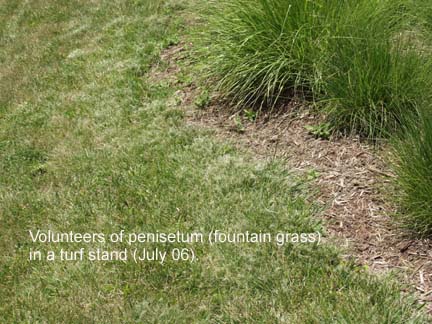
Brown Patches in Lawns Could be Escaped Fountain Grass

Fountain grass and other ornamental grasses have added tremendously to the urban landscape. However, we are now seeing some of these grasses escape from the ornamental beds into the turf. One in particular is fountain grass (Penisetum spp) because it produces viable seeds which blow into surrounding turf and may germinate. Though most of the…Read more about Brown Patches in Lawns Could be Escaped Fountain Grass[Read More]

 Categories:

Bermuda suppression in zoysia?

Bermudagrass is one of the most difficult species to control due to its extensive stolon and rhizome system, aggressive growth, and tolerance to management and environmental extremes. It is even more difficult to control selectively in another warm season grass, thus it can be a problem wherever zoysiagrass is grown as the desirable turf. Recent…Read more about Bermuda suppression in zoysia?[Read More]

 Categories:

Aerification Following Preemergence Herbicide?

In theory, a barrier of preemergene herbicide is created in the soil and limites emergence of crabgrass. Any gap in this barrier could allow crabgrass to germinate. This is why a uniform application of preemergence herbicide is required and practices like power raking or aerification are usually not recommended after application. However, research consistently shows…Read more about Aerification Following Preemergence Herbicide?[Read More]

 Categories:

Time is Running Out for Preemergence Control of Crabgrass

April 15-20 usually marks the end of the window for applying traditional preemergence herbicides in central IN, a week earlier in southern IN, and a week later in northern IN. Though most preemergence herbicides do have minor post-emergence properties that will burn back small crabgrass (one or two leaf stage), this is not always reliable….Read more about Time is Running Out for Preemergence Control of Crabgrass[Read More]

 Categories:

Spring Dandelion Control for Professionals

Many turf areas did not get treated for broadleaf weeds last fall because of the dry fall combined with the fairly early snowfall. Though fall applications are most effective for controlling broadleaf weeds, spring applications are warranted for new lawns or areas that did not get treated last fall. Spring applications will be most effective…Read more about Spring Dandelion Control for Professionals[Read More]

 Categories:

Page last modified: May 21, 2019

Turfgrass Science at Purdue University - Horticulture & Landscape Architecture, 625 Agriculture Mall, West Lafayette, IN 47907

© 2026 Purdue UniversityAn equal access/equal opportunity universityCopyright ComplaintsMaintained by Turfgrass Science at Purdue University

If you have trouble accessing this page because of a disability, please contact Turfgrass Science at Purdue University at kkalbaug@purdue.eduAccessibility Resources