Turf Tips Archives


For professionals only: Poa annua seedheads

Poa annua seedheads are just around the corner in most of Indiana and it’s high time to apply Embark or Proxy/Primo for seedhead reduction on golf courses. The seedhead models on our GDD Tracker at http://www.gddtracker.net indicate most of Indiana should be applying now. Embark and Proxy/Primo can effectively reduce seedheads of Poa annua, which tends to allow the Poa to…Read more about For professionals only: Poa annua seedheads[Read More]

 Categories:

Billbugs on the move in Southern Indiana

Superintendants and lawn care professionals in the southernmost counties of Indiana should be advised that adult billbug activity has already been documented at one of the monitoring sites in the Evansville area.  Mr. Jeff Sexton, Assistant Superintendant at Rolling Hills Country Club in Newburgh, Indiana captured his first billbugs adults of the year last week. …Read more about Billbugs on the move in Southern Indiana[Read More]


Lots of Colors in Spring Lawns

During spring green-up, lawns may reveal many variations in color, growth rate, and leaf width. This variation can be due to some of the following reasons: Species and cultivars:  Perennial ryegrass is always the first of the desired cool-season grasses to green-up, followed by tall fescue and eventually Kentucky bluegrass (Fig. 1). Even within a species,…Read more about Lots of Colors in Spring Lawns[Read More]


Winter damage in cool-season turf

I’ve gotten a number of calls on winter damage on lawns and other high mowed turf areas. Thankfully this is fairly rare in most winters throughout Indiana. Winterkill can be fairly complex resulting from desiccation with drying winds, freezing of the plant crown with quickly dropping temperatures after spring green up, and/or from direct cell…Read more about Winter damage in cool-season turf[Read More]


Turf 101: Spring Mowing

Though lawns in southern Indiana may have already been mowed a couple of times, mowing is just starting from Indianapolis north.  Mowing is the most expensive and laborious maintenance practice on turf, but it also has the largest effect on long-term performance: It is better to mow too early rather than too late in the…Read more about Turf 101: Spring Mowing[Read More]


Turf 101: Limit Spring Fertilization

Many different strategies exist on spring fertilization, but the one fact agreed upon by all turf specialists is to avoid applying heavy nitrogen (N) rates in March or April. Heavy rates would be anything greater than 0.75 lbs of quickly available N/1000 ft2, which causes excessive shoot growth and results in frequent mowing. Furthermore, excess…Read more about Turf 101: Limit Spring Fertilization[Read More]


MSMA is a “stop sale” agreement, not a “stop use”

As a follow up to the Feb. 13 Turf Tip on the new restrictions on MSMA, the Indiana Office of the State Chemist indicates this is “stop sale agreement” and not a “stop use”. Therefore, you are free to use according to the label on the actual container, any MSMA that you have in storage…Read more about MSMA is a “stop sale” agreement, not a “stop use”[Read More]

 Categories:

Professionals Only: Syngenta’s Tenacity receives federal label for residential and sports turf

After much delay, Tenacity has finally received its federal label for residential and sports turf. That’s the good news, but the bad news is that state labeling is still ongoing and it won’t be for sale likely until Fall 2009 or early 2010. Experimental product is available on a limited basis from your Syngenta rep…Read more about Professionals Only: Syngenta’s Tenacity receives federal label for residential and sports turf[Read More]

 Categories:

Seed now to get a jump on crabgrass germination

Though spring is not our favorite time to seed, it’s important to seed as soon as possible to allow the cool-season grasses to germinate prior to crabgrass. Crabgrass germinations can occur at soil surface temperatures as low as 50F, but germination is slow and these plants (hopefully) may be killed by an ensuing frost. Most…Read more about Seed now to get a jump on crabgrass germination[Read More]

 Categories:

Tracking Growing Degree Days for Applications? Indiana now in expanded GDD Tracker

By popular demand, we have joined with Michigan State to include Indiana sites in GDD Tracker (http://www.gddtracker.net/). This site allows you to quickly and easily check your current growing degree day accumulation. It also uses a number of models to help with decisions on timing of growth regulators for Poa annua seedheads, preemergence herbicides for crabgrass, and…Read more about Tracking Growing Degree Days for Applications? Indiana now in expanded GDD Tracker[Read More]


Professionals Only: Premergence herbicide strategies

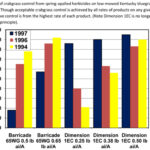
As spring is closing in, we are fielding a number of questions; four major questions right now: Which preemergnce herbide to use? That one is pretty easy. We have only three active ingredients relatively easily available and they are dithiopyr, pendimethalin, and prodiamine. Our research shows that as long as they are applied at reasonable…Read more about Professionals Only: Premergence herbicide strategies[Read More]

 Categories:

MSMA still available but use is limited

Though MSMA is rarely used by professionals anymore in cool-season turf, it is an excellent postemergent crabgrass herbicide for zoysia and bermudagrass grown in the southern half of Indiana. It is especially useful during sprigging or seeding operations because it is safe on seedlings. Following is a brief summary of the current status and the…Read more about MSMA still available but use is limited[Read More]

 Categories:

Purdue Team WINS the 2009 GCSAA TURF Quiz Bowl Competition!!!

Six teams traveled last week to the International Golf Industry Show in New Orleans, LA to compete in the 15th annual Golf Course Superintendents Association of America (GCSAA) Collegiate Turf Quiz Bowl. This competition consists of a 3.5 hour written examination that consists of the identification of seeds, turfgrasses, diseases, insects and weeds.  In addition…Read more about Purdue Team WINS the 2009 GCSAA TURF Quiz Bowl Competition!!![Read More]

 Categories:

Preemergence Yellow Nutsedge Control In Spring Seeded Tall Fescue With Tenacity, Dismiss and Echelon, 2007

Summary: This study showed that Dismiss and Echelon provided excellent preemergence yellow nutsedge control, but these herbicides should not be used in a tall fescue seedbed. Tenacity applied twice at 0.1 87 lb/A provided a level of yellow nutsedge control similar to Dismiss and Echelon. However, Tenacity works slowly and must be applied twice to…Read more about Preemergence Yellow Nutsedge Control In Spring Seeded Tall Fescue With Tenacity, Dismiss and Echelon, 2007[Read More]

 Categories:

Yellow Nutsedge, The Scourge of Lawns and Landscapes in Nebraska

Yellow nutsedge (Cyperus esculentus) is a common, persistent and troublesome weed in lawns and landscapes in Nebraska. This is especially true from Kearney east into Iowa. Yellow nutsedge thrives in waterlogged soil and their presence often indicates that drainage is poor, irrigation frequency/quantity are excessive, or sprinklers/valves are damaged and leaking. Once this tenacious weed…Read more about Yellow Nutsedge, The Scourge of Lawns and Landscapes in Nebraska[Read More]


Yellow nutsedge may be far off concern, but spring applications show promise

Yellow nutsedge is now one of the most common weeds in lawns, athletic fields and golf turf. Even though all textbooks say it thrives in wet areas, we see some of our worst yellow nutsedge infestations in dry years. Cultural controls will always help, but the standard herbicides are Basagran, SedgeHammer (formerly Manage), Certainty, and…Read more about Yellow nutsedge may be far off concern, but spring applications show promise[Read More]

 Categories:

Calculating the pounds of fertilizer to apply

There are literally thousands of fertilizers and fertilizer/pesticide combinations available to homeowners and professionals. Therefore, we can’t recommend how many pounds of a specific fertilizer to apply, but rather we must recommend fertilization rates in pounds of nitrogen per thousand square feet or lbs N/1000 sq ft. You can use our fertilizer calculator at www.agry.purdue.edu/turf/fertcalc/Fertilization%20calc.html…Read more about Calculating the pounds of fertilizer to apply[Read More]


Choosing a Preemergence Herbicide

There are many, many formulations and combinations of preemergence herbicides available for the professional. Following are some suggestions for purchasing and using preemergence herbicides. Control from every preemergence herbicide can vary from year to year, or location to location. Therefore, you can’t judge the performance of a product or a specific rate of that product…Read more about Choosing a Preemergence Herbicide[Read More]

 Categories:

Thank You to Everyone who Attended the Indiana Green Expo

On behalf of the Turf Program, Midwest Regional Turf Foundation (MRTF), Indiana Nursery and Landscape Association (INLA), and Indiana Flower Growers Association (IFGA), I’d like to thank everyone who helped with and/or attended the 2009 Indiana Green Expo on January 12-14 at the Indiana Convention Center in Indianapolis.  This marks the third year of cooperation…Read more about Thank You to Everyone who Attended the Indiana Green Expo[Read More]

 Categories:

Purdue Alumni and Friends Reception at the GCSAA in New Orleans

For those making the trip to New Orleans for the Golf Industry Show, the Purdue Alumni and Friends Reception will be held Thursday, February 5, 6:00 to 8:00 pm in the Bayoe Jean Lafitte room of the Embassy Suites, 315 Julia Street.  It’s a great opportunity to catch up with your classmates and old friends….Read more about Purdue Alumni and Friends Reception at the GCSAA in New Orleans[Read More]

 Categories:

Page last modified: May 31, 2019

Turfgrass Science at Purdue University - Horticulture & Landscape Architecture, 625 Agriculture Mall, West Lafayette, IN 47907

© 2026 Purdue UniversityAn equal access/equal opportunity universityCopyright ComplaintsMaintained by Turfgrass Science at Purdue University

If you have trouble accessing this page because of a disability, please contact Turfgrass Science at Purdue University at kkalbaug@purdue.eduAccessibility Resources