Turf Tips Archives


Summer stress of Poa annua, Poa trivialis on Golf Courses

Persistent air tempertatures of 90F and soil temperatures greater than 80F combine with high humidity and adequate rainfall (in some areas) is doing in the Poa annua (annual bluegrass)and Poa trivialis (rough bluegrass)on golf courses. After a week or two of these conditions, Poa annua greens and fairways will start to thin and die in…Read more about Summer stress of Poa annua, Poa trivialis on Golf Courses[Read More]


Summer stress of Poa annua and Poa trivialis in Lawns and Sports Fields

Persistent air temperatures of 90F and soil temperatures greater than 80F combine with high humidity and adequate rainfall (in some areas) is also doing in the Poa annua (annual bluegrass) and Poa trivialis (rough bluegrass)on lawns and athletic fields. Patches of these fine-bladed grasses seemingly die overnight with even a minimum of drought stress. Though…Read more about Summer stress of Poa annua and Poa trivialis in Lawns and Sports Fields[Read More]


Bumper Crop of Crabgrass and Yellow Nutsedge

The rain and 90F temperatures have boosted the growth of both crabgrass and yellow nutsedge in the last week or two. Unfortunately, our options for control of either weed are becoming limited. Plus the hot temperatures increase the risk for turf damage with any herbicide applied now. The best current option for crabgrass is Drive…Read more about Bumper Crop of Crabgrass and Yellow Nutsedge[Read More]

 Categories:

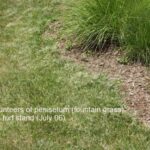
Brown Patches in Lawns Could be Escaped Fountain Grass

Fountain grass and other ornamental grasses have added tremendously to the urban landscape. However, we are now seeing some of these grasses escape from the ornamental beds into the turf. One in particular is fountain grass (Penisetum spp) because it produces viable seeds which blow into surrounding turf and may germinate. Though most of the…Read more about Brown Patches in Lawns Could be Escaped Fountain Grass[Read More]

 Categories:

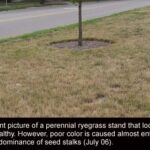
Brown Patches in Lawns Could be Old Seedstalks

We have received a number of calls, email, and electronic photos inquiring about current brown patches in the lawn. Dollar spot is active throughout the state and could be causing problems in lawns. Dollar spot causes very noticeable lesions and cotton candy mycelium in the early morning. However, many of the patches that I have…Read more about Brown Patches in Lawns Could be Old Seedstalks[Read More]

 Categories:

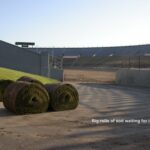
Bermudagrass Takes Root in Ross-Ade and the South Football Practice Field

It is in some ways difficult to believe that it has been just over one month since the first “Big Rolls” of ‘Patriot’ bermudagrass were installed in Ross-Ade stadium on 6 June, 2006. The sod 42” wide rolls arrived on refrigerated trucks from the sandy coastal plain soils of Eastern Maryland. Some of you may…Read more about Bermudagrass Takes Root in Ross-Ade and the South Football Practice Field[Read More]

 Categories:

Midwest Regional Turf Field Day on July 18

Don’t forget to register for the Midwest Regional Turf Field Day that will be held on July 18 at the W.H. Daniel Turfgrass Research and Diagnostic Center in West Lafayette. This is a great opportunity for turf professionals to view the latest in turfgrass research, talk to Purdue specialists about turf and ornamental issues, and…Read more about Midwest Regional Turf Field Day on July 18[Read More]

 Categories:


Bermuda suppression in zoysia?

Bermudagrass is one of the most difficult species to control due to its extensive stolon and rhizome system, aggressive growth, and tolerance to management and environmental extremes. It is even more difficult to control selectively in another warm season grass, thus it can be a problem wherever zoysiagrass is grown as the desirable turf. Recent…Read more about Bermuda suppression in zoysia?[Read More]

 Categories:

More on Nematodes and Indiana Greens

As our nematode survey continues, more questions are being asked about nematodes, their damage potential, etc. Following is an update on the survey:  Do not attribute all vague symptoms to nematodes. Nematode populations and symptoms are extremely complex and cannot be diagnosed by anyone other than a nematologist. In other words, don’t panic. …Read more about More on Nematodes and Indiana Greens[Read More]


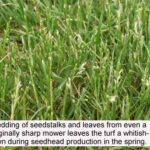
Seedheads Make for Tough Mowing

Kentucky bluegrass, tall fescue, and perennial ryegrass are now producing seedheads. This natural phenomenon is induced by daylength and occurs every spring. Seedheads detract from the appearance of a turf because they grow quickly and unevenly and the tough seed stalks do not cut cleanly except with the sharpest of mower blades. After mowing, the…Read more about Seedheads Make for Tough Mowing[Read More]


Red thread, pink patch, and dollar spot in lawns and roughs

Red thread and its close relative pink patch, are now appearing on home lawns (and golf course roughs) in the central and southern parts of Indiana. Red thread first appears as small (quarter to golf ball size) gray – tan colored patches in the turf. After extended dew periods, white – pink mold may be…Read more about Red thread, pink patch, and dollar spot in lawns and roughs[Read More]


Football Renovations Continue (Part 2)

Tremendous progress has occurred since our last update, 17 May, on the projects to enhance the football practice and game fields at Purdue University. These have been exciting times for all those associated with the Turf program as we have been able to witness three different turf renovation projects all occurring simultaneously. It has truly…Read more about Football Renovations Continue (Part 2)[Read More]

 Categories:

Finding Spring Grubs?

Each spring we receive many calls about grubs as people find them while planting gardens or ornamental beds. These are often large and appear menacing however do not let their appearance cause you to worry, panic or run out to buy an insecticide to annihilate these sinister creatures. These grubs are not feeding actively so…Read more about Finding Spring Grubs?[Read More]

 Categories:

Ross-Ade and South Football Practice Field Renovations – Update 17 May 2006

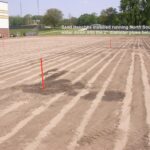
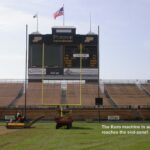
After nearly a week of steady rain in West Lafayette and across the region, work was finally able to continue on the Ross-Ade stadium and South football practice field renovations. The existing Kentucky bluegrass/perennial ryegrass turf in Ross-Ade was removed today with a “Koro” machine. The machine is essentially analogous to a milling machine used…Read more about Ross-Ade and South Football Practice Field Renovations – Update 17 May 2006[Read More]


Aerification Following Preemergence Herbicide?

In theory, a barrier of preemergene herbicide is created in the soil and limites emergence of crabgrass. Any gap in this barrier could allow crabgrass to germinate. This is why a uniform application of preemergence herbicide is required and practices like power raking or aerification are usually not recommended after application. However, research consistently shows…Read more about Aerification Following Preemergence Herbicide?[Read More]

 Categories:

Pink Snow Mold Active

The cool wet weather the last two weeks is favoring Microdochium nivale, the pathogen that causes pink snow mold (sometimes referred to as Microdochium patch). The color of pink snow mold scars indicates the activity of the patch. Straw colored patches are usually inactive. However, a rust to orange colored band or ring indicates an active…Read more about Pink Snow Mold Active[Read More]

 Categories:

Rhizoctonia Large Patch in Bermudagrass

With the continued cool wet weather, Rhizoctonia Large Patch (RLP) is affecting bermudagrass fairways. Prior to widespread use of bermudagrass in southern Indiana and northern Kentucky, we thought RLP affected only zoysia and was thus known as zoysia patch. However, RLP caused serious thinning in bermudagrass in an occasional spring the last few years. This…Read more about Rhizoctonia Large Patch in Bermudagrass[Read More]

 Categories:

Rhizoctonia Large Patch (Zoysia Patch) in Zoysia

With the continued cool wet weather, Rhizoctonia Large Patch (RLP or zoysia patch) is in high gear. This follows a warm winter that also encouraged RLP, which is the only major disease of zoysiagrass in Indiana. Like snow mold, a rust to orange colored band on the outside of the patch indicates activity. Though best…Read more about Rhizoctonia Large Patch (Zoysia Patch) in Zoysia[Read More]

 Categories:

Mowing Wet Grass

With the rainy weather lately, it is inevitable that you will have to mow when it is wet. Though we much prefer to mow when the grass is dry, it is better to mow when wet rather than waiting until the grass is dry but grown to 8 inches tall. A couple of pointers for…Read more about Mowing Wet Grass[Read More]


Page last modified: May 20, 2019

Turfgrass Science at Purdue University - Horticulture & Landscape Architecture, 625 Agriculture Mall, West Lafayette, IN 47907

© 2026 Purdue UniversityAn equal access/equal opportunity universityCopyright ComplaintsMaintained by Turfgrass Science at Purdue University

If you have trouble accessing this page because of a disability, please contact Turfgrass Science at Purdue University at kkalbaug@purdue.eduAccessibility Resources