Zac Reicher

337 articles by this author

Turf Tips List

Common Chickweed in New Seedlings

Common chickweed is currently dominating any fall- or dormant-seedings (including my lawn). Common chickweed is a winter annual, so it germinated last fall, grew well into December and is starting to spread with the temperatures this weekend (see accompanying photos). In established lawns, I wouldn’t recommend spraying it because it will die with the first…Read more about Common Chickweed in New Seedlings[Read More]

Spring Weed Control or Seeding?

With last year’s brutal summer and early fall, many areas are in need of reseeding. The question comes up about seeding and weed control: should the weeds be controlled first or should the seeding be done first? This seems like a simple question, but it’s fairly complex depending on the turf and weed species present…Read more about Spring Weed Control or Seeding?[Read More]

 Categories:

Herbicide Delays after Seeding

Almost all herbicides will affect turfgrass seedlings and application delays are usually needed following seeding. Following is information gleaned from available labels of most herbicides or herbicide types that would be used in Indiana. This is intended to provide a general idea of the limitations of each active ingredient, but please refer to the actual…Read more about Herbicide Delays after Seeding[Read More]

 Categories:

Timing of Preemergence Herbicides

If a preemergence herbicide is justified on a turf area, the timing of application is important. In theory, applying too early will expose the herbicide to soil microbes and processes in the soil that may break it down, allowing crabgrass to germinate during the latter part of the summer. Conversely, applying too late may miss…Read more about Timing of Preemergence Herbicides[Read More]

 Categories:

Choose Preemergence herbicides with as Little N as Possible

If a preemergence herbicide is justified on your lawn to control crabgrass now, most of those are available combined with fertilizer and you are forced to apply a fertilizer now. Look for a product with low nitrogen and be sure the majority of the nitrogen is a slow release N. Slow release sources include sulfur-…Read more about Choose Preemergence herbicides with as Little N as Possible[Read More]

 Categories:

There are still openings for the IN-IL Turfgrass Short Course

The IN-IL Turfgrass Short Course will be held in two locations in 2006, in Indianapolis on Feb. 13-16 and in Willowbrook, IL, on Feb. 27-March 2. This is an outstanding course for new and experienced turf professionals. It’s designed for turf managers with some experience and an understanding of HOW we maintain turf, and meant…Read more about There are still openings for the IN-IL Turfgrass Short Course[Read More]

 Categories:

IN-IL Turfgrass Short Course to be Offered in Indianapolis

The IN-IL Turfgrass Short Course will be held in two locations in 2006, in Indianapolis on Feb. 13-16 and in Willowbrook, IL, on Feb. 27-March 2. This is an outstanding course for new and experienced turf professionals. It’s designed for turf managers with some experience and an understanding of HOW we maintain turf, and meant…Read more about IN-IL Turfgrass Short Course to be Offered in Indianapolis[Read More]

 Categories:

Great Education/Tradeshow at the Turf Expo

The Midwest Turf Expo will be held on January 17-19, 2006 at the Indiana Convention Center in Indianapolis. An outstanding educational schedule compliments a rapidly filling tradeshow held in conjunction with the Indiana Park and Recreation Association. A GCSAA Seminar on understanding soils kicks off the Expo on Tuesday afternoon. Concurrent educational session begin on…Read more about Great Education/Tradeshow at the Turf Expo[Read More]

 Categories:

IN-IL Turfgrass Short Course to be Offered in Indianapolis

The IN-IL Turfgrass Short Course will be held in two locations in 2006, in Indianapolis on Feb. 13-16 and in Willowbrook, IL, on Feb. 27-March 2. This is an outstanding course for new and experienced turf professionals. It’s designed for turf managers with some experience and an understanding of HOW we maintain turf, and meant…Read more about IN-IL Turfgrass Short Course to be Offered in Indianapolis[Read More]

 Categories:

November Fertilization is Money in the Bank

A November application of fertilizer is extremely important to keep your lawn healthy and looking good this fall and next year. Late fall N promotes good root development, enhances storage of energy reserves, and extends color retention this fall. Most of the benefits from late fall N will be seen next spring and summer with…Read more about November Fertilization is Money in the Bank[Read More]


Now is the Time to Control Dandelions

Those dandelions, clover, and other broadleaf weeds that were a problem all summer should be controlled this fall. The period from late September through October is the ideal time to control broadleaf weeds in turfgrass because broadleaf weeds are most susceptible to herbicides at this time. The turf and weeds must be green and actively…Read more about Now is the Time to Control Dandelions[Read More]

 Categories:

Winterizer Fertilizers

Currently advertised on television and in home improvement stores are “winterizer” fertilizers. There’s good and bad about winterizer fertilizers. It’s good that they are emphasizing fall and late fall fertilizer. These fertilizers usually contain the same amount of potassium as nitrogen (nitrogen is the first of the three prominent numbers on the bag while potassium…Read more about Winterizer Fertilizers[Read More]


Keep Mowing to Mulch Those Tree Leaves!

The trees are dropping their leaves and it is important to prevent a heavy layer of leaves from building-up on your turf before winter. Heavy layers of tree leaves that shade the grass can smother and kill grass yet this fall. Plus tree leaf cover favors a damaging winter turf disease called snow mold. The…Read more about Keep Mowing to Mulch Those Tree Leaves![Read More]


Turf 101: Why does a November application of fertilizer work?

Nitrogen stimulates increased photosynthesis and the extra energy derived from this goes directly into growth, respiration to maintain the plant (similar to humans), or into storage. In early November, the temperature is still adequate for photosynthesis, but cool enough to minimize respiration demands and too cold for significant growth. Therefore, most of the extra energy…Read more about Turf 101: Why does a November application of fertilizer work?[Read More]


Turf 101: Why are broadleaf herbicides more effective in the fall than spring?

Late September through October is the best time to control weeds like dandelion, clover, and chickweed with an application of a broadleaf weed herbicide. Broadleaf weed herbicides are systemic and move through the plant in the phloem, which also transports photosynthate. The more areas of the plant that the herbicide translocates to, the more effective…Read more about Turf 101: Why are broadleaf herbicides more effective in the fall than spring?[Read More]

 Categories:

Hot August and September = Poor Rooting = Bad Footing for Sports Fields

For anyone who watched major college football in the Midwest this fall, you’ve noticed that the fields are tearing up with divots and blow outs. Some major universities have even resodded their fields after the opening few games in hopes of improving traction. In a nutshell, this is why fields are tearing up:  Root…Read more about Hot August and September = Poor Rooting = Bad Footing for Sports Fields[Read More]


Randy Brehmer Receives Agronomic Award of Distinction from Purdue University

At this weekend’s Homecoming activities, Randy Brehmer will receive the Agronomic Award of Distinction from Purdue’s Department of Agronomy. This award is reserved for those who have gone above and beyond the call of duty to help the Department of Agronomy and Randy is especially deserving of this award for all he has done to…Read more about Randy Brehmer Receives Agronomic Award of Distinction from Purdue University[Read More]

 Categories:

How late can you seed?

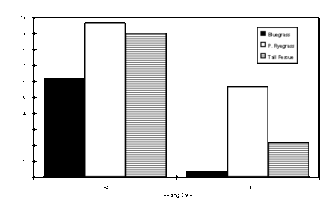
We are out of the optimum window for seeding turfgrasses in Indiana. However, many are still hoping to seed. Following is a summary of our studies in the early 90’s on seeding at less than optimum times of the year. For optimum establishment, seeding should be done in late August or early September. Waiting as…Read more about How late can you seed?[Read More]


Tough Year for Turf in Indiana

The summer’s heat and humidity have taken an unusually high toll on turf in lawns, athletic fields, and golf courses. Most of the decline can be attributed to poor root growth weakening cool-season grasses and starting an avalanche of secondary factors leading to further decline. Root growth of cool-season grasses reaches a peak in mid-spring…Read more about Tough Year for Turf in Indiana[Read More]


No Rush on Broadleaf Weed Applications

After the rains have returned, broadleaf weed herbicides should become effective. However, don’t be in too much of a rush to apply because our data suggests that better control is obtained with October applications in than in September. We found that herbicides applied from October 1 through November 1 improved long-term ground ivy control compared…Read more about No Rush on Broadleaf Weed Applications[Read More]

 Categories: