Turf Tips Archives


September is a Crucial Time to Fertilize All Cool-Season Turfs

Early to mid-September is the most important time to fertilize cool-season turfgrasses like creeping bentgrass, Kentucky bluegrass, perennial ryegrass, and tall or fine fescue. September fertilization is crucial on all turf areas regardless if it is a lawn, athletic field, or golf course green, tee or fairway. Fertilization in mid-September encourages the production of new…Read more about September is a Crucial Time to Fertilize All Cool-Season Turfs[Read More]
Seed Now!

We’re still in the middle of the optimum seeding window for cool-season turfgrasses. The optimum time to seed cool-season turfgrasses is between Aug. 15 and Sept. 15 in central IN, a week earlier in northern IN, and a week or so later in southern IN. It is important to seed as earlier as you can…Read more about Seed Now![Read More]


More Evidence for Effectiveness of Fall Applications of Broadleaves

It’s been fairly well established that fall applications of herbicides are more effective than spring applications for broadleaf control. Recent work in Nebraska reported that applications of 2,4-D and/or dicamba were far more effective in controlling dandelions and Canada thistle when applied 1 to 10 days after the first fall frost than when applied 5…Read more about More Evidence for Effectiveness of Fall Applications of Broadleaves[Read More]

 Categories:

Wait to Control Broadleaf Weeds

Though many broadleaf weeds like ground ivy, clover, and plantain are currently thriving in turf areas, resist the urge to spray them now. Following is a summary of a study that we discussed at Field Day that can help professionals improve broadleaf weed control, especially difficult-to-control weeds like ground ivy. Background Ground ivy is difficult…Read more about Wait to Control Broadleaf Weeds[Read More]

 Categories:

Rust in Turf

The rain and temperatures this year have favored excellent turfgrass growth, and the N applied this spring is being depleted, thus favoring rust in even regularly fertilized turf areas. Rust symptoms are reddish-orange lesions or spots on the leaf blades and a rust-colored powder that you can rub off with your fingers. Rust will rarely…Read more about Rust in Turf[Read More]


Turf Field Day Held July 27

Thanks to everyone who attended and helped make the 2004 Midwest Regional Turf Field Day a success on Tuesday, July 27. A clear day with temperatures in the 70’s was almost perfect for the nearly 700 attendees. Attendees had the opportunity to view the latest in turfgrass research, visit with Purdue specialists, see the most…Read more about Turf Field Day Held July 27[Read More]

 Categories:

Thinning Turf Around Lawn Perimeter from zero-turning radius mowers

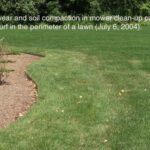
The popularity of the new zero-turning radius mowers is well-justified in terms of time and energy saving devices. However, these mowers are much heavier and faster than walk-behind mowers and thus increase compaction and turf wear. This is especially important around the perimeter of lawns (commonly referred to as the clean-up passes) where the mower…Read more about Thinning Turf Around Lawn Perimeter from zero-turning radius mowers[Read More]


Brown Tracks in Lawn

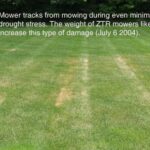
I’ve seen lawns and heard this week about brown streaks that are about the width of the mower (photo). In the vast majority of the cases, these tracks are caused by the weight of a mower traversing across a portion of the lawn that was drought-stressed. Drought stress may not have been easily visible before…Read more about Brown Tracks in Lawn[Read More]


Reminder of Midwest Regional Turf Field Day on July 27

The Midwest Regional Turf Field Day will be held on July 27 at the Wm H Daniel Turfgrass Research and Diagnostic Center in West Lafayette. This is a great opportunity for turf professionals to view the latest in turfgrass research, talk to Purdue specialists about turf and ornamental issues, and visit with exhibitors displaying the…Read more about Reminder of Midwest Regional Turf Field Day on July 27[Read More]

 Categories:

News about Japanese beetles is mostly bad!

Japanese beetles are back! They appeared 10 days to 2 weeks earlier than normal this year and indications are pointing to a very heavy population in many parts of the state. Last years weather conditions kept soils moist which apparently led to a very successful grub hatch. Early emergence usually points to a somewhat earlier…Read more about News about Japanese beetles is mostly bad![Read More]


Finicky Poa annua Yellowing and Thinning on Greens

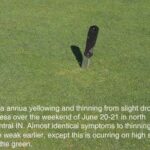
In spite of the cool and dry weather, Poa annua continues to yellow and sometimes thin on golf greens. Last week Poa annua was thinning and dieing in low areas from too much water, heat, and humidity (photo). However, the cool dry weather over the weekend allowed for maximum water loss through evapotranspiration. Plus since many irrigation systems were…Read more about Finicky Poa annua Yellowing and Thinning on Greens[Read More]


Summer stress of Poa annua and Poa trivialis in Lawns and Sports Fields

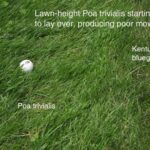
Poa annua (annual bluegrass) and Poa trivialis (rough bluegrass) in athletic fields and lawns are starting to show signs of stress. The signs of stress include laying over (poor mow-ability), yellowing, and thinning. Patches of these fine-bladed grasses seemingly die overnight with even a minimum of drought stress. Though these grasses may have blended in with the desired turf…Read more about Summer stress of Poa annua and Poa trivialis in Lawns and Sports Fields[Read More]


White Clover in Golf Courses, Sports Turf, and Lawns

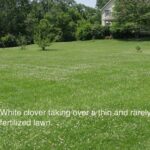
The small white flowers of white clover are very visible right now and it may appear that clover is taking over, especially under-fertilized turf areas. Clover is a legume and is very competitive under low N conditions, so increasing annual N is best method for long-term control. The temptation is to apply a herbicide now…Read more about White Clover in Golf Courses, Sports Turf, and Lawns[Read More]


Dealing With Flood Damage

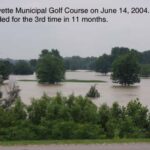
Though flooding damage so far this year is not as bad as last year, a number of areas have been hard hit with rainfall the last week (see the photo of Lafayette Municipal Golf Course). We don’t expect damage to be as extensive as last summer given the slightly lower temperatures, but some areas will…Read more about Dealing With Flood Damage[Read More]


Doug Richmond Joins Turf Program in Entomology Research

Dr. Doug Richmond has recently accepted the turfgrass entomology faculty position at Purdue University. Doug is the first of the projected six positions of Purdue’s initiative on sustainable urban ecosystems. Dr. Richmond joins the Turf Program after completing his M.S. and Ph.D. and Ohio State University in Columbus under Dr. David Shetlar and his Post…Read more about Doug Richmond Joins Turf Program in Entomology Research[Read More]

 Categories:

Midwest Regional Turf Field Day on July 27

The Midwest Regional Turf Field Day will be held on July 27 at the Wm H Daniel Turfgrass Research and Diagnostic Center in West Lafayette. This is a great opportunity for turf professionals to view the latest in turfgrass research, talk to Purdue specialists about turf and ornamental issues, and visit with exhibitors displaying the…Read more about Midwest Regional Turf Field Day on July 27[Read More]

 Categories:


Time to consider a change…?

We are finally getting near the end of the spring growth flush for our major cool-season lawngrass species like Kentucky bluegrass, ryegrass and tall fescue. With a little help from mother-nature, hopefully mowing will be more manageable from here on out. During the past few weeks you may have noticed a decline in overall appearance…Read more about Time to consider a change…?[Read More]


Early Dollar Spot on Golf Courses This Year

If you’re lucky enough to be in the areas of Indiana that have received ample rainfall, you are unfortunately starting to see dollar spot. The excess rain in parts of the state triggered rapid plant growth and infrequent mowing, which in turn forced clipping removal and removal of N from the system. The N in…Read more about Early Dollar Spot on Golf Courses This Year[Read More]


Localized Dry Spot Returns for 2004

For those of you managing sand-based putting greens you may have noticed some turf areas that don’t seem to be vigorously growing even with the recent heavy rainfalls or regular irrigation (photo). Looking back, April and the early part of May was a challenging time for turf managers trying to manage water on the golf…Read more about Localized Dry Spot Returns for 2004[Read More]


Page last modified: May 15, 2019

Turfgrass Science at Purdue University - Horticulture & Landscape Architecture, 625 Agriculture Mall, West Lafayette, IN 47907

© 2026 Purdue UniversityAn equal access/equal opportunity universityCopyright ComplaintsMaintained by Turfgrass Science at Purdue University

If you have trouble accessing this page because of a disability, please contact Turfgrass Science at Purdue University at kkalbaug@purdue.eduAccessibility Resources