Homeowner


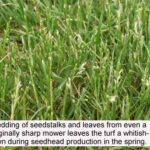
Seedheads Make for Tough Mowing

Kentucky bluegrass, tall fescue, and perennial ryegrass are now producing seedheads. This natural phenomenon is induced by daylength and occurs every spring. Seedheads detract from the appearance of a turf because they grow quickly and unevenly and the tough seed stalks do not cut cleanly except with the sharpest of mower blades. After mowing, the…Read more about Seedheads Make for Tough Mowing[Read More]
Red thread, pink patch, and dollar spot in lawns and roughs

Red thread and its close relative pink patch, are now appearing on home lawns (and golf course roughs) in the central and southern parts of Indiana. Red thread first appears as small (quarter to golf ball size) gray – tan colored patches in the turf. After extended dew periods, white – pink mold may be…Read more about Red thread, pink patch, and dollar spot in lawns and roughs[Read More]


Finding Spring Grubs?

Each spring we receive many calls about grubs as people find them while planting gardens or ornamental beds. These are often large and appear menacing however do not let their appearance cause you to worry, panic or run out to buy an insecticide to annihilate these sinister creatures. These grubs are not feeding actively so…Read more about Finding Spring Grubs?[Read More]

 Categories:

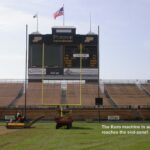
Ross-Ade and South Football Practice Field Renovations – Update 17 May 2006

After nearly a week of steady rain in West Lafayette and across the region, work was finally able to continue on the Ross-Ade stadium and South football practice field renovations. The existing Kentucky bluegrass/perennial ryegrass turf in Ross-Ade was removed today with a “Koro” machine. The machine is essentially analogous to a milling machine used…Read more about Ross-Ade and South Football Practice Field Renovations – Update 17 May 2006[Read More]


Mowing Wet Grass

With the rainy weather lately, it is inevitable that you will have to mow when it is wet. Though we much prefer to mow when the grass is dry, it is better to mow when wet rather than waiting until the grass is dry but grown to 8 inches tall. A couple of pointers for…Read more about Mowing Wet Grass[Read More]


First Black Cutworms of the Year Found in Traps

Recent storms have generated the weather patterns that bring black cutworm moths into our state each year. Pheromone traps picked up the first black cutworm moths of the season during the past two weeks. Predictive models estimate that the first cutworm caterpillars will begin feeding 300 heat units after the first moths are caught. Unseasonably…Read more about First Black Cutworms of the Year Found in Traps[Read More]


Spring Dandelion Control Still Not as Effective as Fall Control

The annual bloom of dandelions is already here in southern and central Indiana. This marks the beginning of the second most effective period for controlling broadleaf weeds. The optimum time to control dandelions and other broadleaf weeds is in the fall and the second most effective time is in late spring, at or shortly after…Read more about Spring Dandelion Control Still Not as Effective as Fall Control[Read More]

 Categories:

Turfgrass Does not Perform Well in the Shade (Period)

We have received a ton of calls in the last week about improving shaded lawns. Following is a summary about shaded lawns:  Turf does not perform well in the shade  “Shade-adapted“ grass species and cultivars will always perform better in full sun compared to shade (regardless of what the label states)  As…Read more about Turfgrass Does not Perform Well in the Shade (Period)[Read More]


Choose Preemergence herbicides with as Little N as Possible

If a preemergence herbicide is justified on your lawn to control crabgrass now, most of those are available combined with fertilizer and you are forced to apply a fertilizer now. Look for a product with low nitrogen and be sure the majority of the nitrogen is a slow release N. Slow release sources include sulfur-…Read more about Choose Preemergence herbicides with as Little N as Possible[Read More]

 Categories:

Rain Gauge Volunteers Needed for CoCoRaHS

What is CoCoRaHS? CoCoRaHS, the Community Collaborative Rain, Hail and Snow network, is a unique, non-profit, community-based, high density network of volunteers of all ages and backgrounds, who take daily measurements of rain and snow in their yards, athletic fields, or golf courses. And now, thanks to a partnership between the Indiana State Climate Office…Read more about Rain Gauge Volunteers Needed for CoCoRaHS[Read More]

 Categories:

Great Education/Tradeshow at the Turf Expo

The Midwest Turf Expo will be held on January 17-19, 2006 at the Indiana Convention Center in Indianapolis. An outstanding educational schedule compliments a rapidly filling tradeshow held in conjunction with the Indiana Park and Recreation Association. A GCSAA Seminar on understanding soils kicks off the Expo on Tuesday afternoon. Concurrent educational session begin on…Read more about Great Education/Tradeshow at the Turf Expo[Read More]

 Categories:

November Fertilization is Money in the Bank

A November application of fertilizer is extremely important to keep your lawn healthy and looking good this fall and next year. Late fall N promotes good root development, enhances storage of energy reserves, and extends color retention this fall. Most of the benefits from late fall N will be seen next spring and summer with…Read more about November Fertilization is Money in the Bank[Read More]


Now is the Time to Control Dandelions

Those dandelions, clover, and other broadleaf weeds that were a problem all summer should be controlled this fall. The period from late September through October is the ideal time to control broadleaf weeds in turfgrass because broadleaf weeds are most susceptible to herbicides at this time. The turf and weeds must be green and actively…Read more about Now is the Time to Control Dandelions[Read More]

 Categories:

Winterizer Fertilizers

Currently advertised on television and in home improvement stores are “winterizer” fertilizers. There’s good and bad about winterizer fertilizers. It’s good that they are emphasizing fall and late fall fertilizer. These fertilizers usually contain the same amount of potassium as nitrogen (nitrogen is the first of the three prominent numbers on the bag while potassium…Read more about Winterizer Fertilizers[Read More]


Keep Mowing to Mulch Those Tree Leaves!

The trees are dropping their leaves and it is important to prevent a heavy layer of leaves from building-up on your turf before winter. Heavy layers of tree leaves that shade the grass can smother and kill grass yet this fall. Plus tree leaf cover favors a damaging winter turf disease called snow mold. The…Read more about Keep Mowing to Mulch Those Tree Leaves![Read More]


Turf 101: Why does a November application of fertilizer work?

Nitrogen stimulates increased photosynthesis and the extra energy derived from this goes directly into growth, respiration to maintain the plant (similar to humans), or into storage. In early November, the temperature is still adequate for photosynthesis, but cool enough to minimize respiration demands and too cold for significant growth. Therefore, most of the extra energy…Read more about Turf 101: Why does a November application of fertilizer work?[Read More]


Turf 101: Why are broadleaf herbicides more effective in the fall than spring?

Late September through October is the best time to control weeds like dandelion, clover, and chickweed with an application of a broadleaf weed herbicide. Broadleaf weed herbicides are systemic and move through the plant in the phloem, which also transports photosynthate. The more areas of the plant that the herbicide translocates to, the more effective…Read more about Turf 101: Why are broadleaf herbicides more effective in the fall than spring?[Read More]

 Categories:

Hot August and September = Poor Rooting = Bad Footing for Sports Fields

For anyone who watched major college football in the Midwest this fall, you’ve noticed that the fields are tearing up with divots and blow outs. Some major universities have even resodded their fields after the opening few games in hopes of improving traction. In a nutshell, this is why fields are tearing up:  Root…Read more about Hot August and September = Poor Rooting = Bad Footing for Sports Fields[Read More]


Randy Brehmer Receives Agronomic Award of Distinction from Purdue University

At this weekend’s Homecoming activities, Randy Brehmer will receive the Agronomic Award of Distinction from Purdue’s Department of Agronomy. This award is reserved for those who have gone above and beyond the call of duty to help the Department of Agronomy and Randy is especially deserving of this award for all he has done to…Read more about Randy Brehmer Receives Agronomic Award of Distinction from Purdue University[Read More]

 Categories:

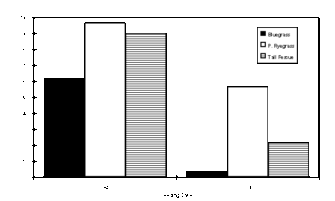
How late can you seed?

We are out of the optimum window for seeding turfgrasses in Indiana. However, many are still hoping to seed. Following is a summary of our studies in the early 90’s on seeding at less than optimum times of the year. For optimum establishment, seeding should be done in late August or early September. Waiting as…Read more about How late can you seed?[Read More]


Page last modified: May 15, 2019

Turfgrass Science at Purdue University - Horticulture & Landscape Architecture, 625 Agriculture Mall, West Lafayette, IN 47907

© 2026 Purdue UniversityAn equal access/equal opportunity universityCopyright ComplaintsMaintained by Turfgrass Science at Purdue University

If you have trouble accessing this page because of a disability, please contact Turfgrass Science at Purdue University at kkalbaug@purdue.eduAccessibility Resources