Homeowner


Tough Year for Turf in Indiana

The summer’s heat and humidity have taken an unusually high toll on turf in lawns, athletic fields, and golf courses. Most of the decline can be attributed to poor root growth weakening cool-season grasses and starting an avalanche of secondary factors leading to further decline. Root growth of cool-season grasses reaches a peak in mid-spring…Read more about Tough Year for Turf in Indiana[Read More]

No Rush on Broadleaf Weed Applications

After the rains have returned, broadleaf weed herbicides should become effective. However, don’t be in too much of a rush to apply because our data suggests that better control is obtained with October applications in than in September. We found that herbicides applied from October 1 through November 1 improved long-term ground ivy control compared…Read more about No Rush on Broadleaf Weed Applications[Read More]

 Categories:

September is a Crucial for Fertilizing All Cool-Season Turfs

With the returning rains in the state, now is the most important time to fertilize cool-season turfgrasses like creeping bentgrass, Kentucky bluegrass, perennial ryegrass, and tall or fine fescue. September fertilization is crucial on all turf areas regardless if it is a lawn, athletic field, or golf course green, tee or fairway. Fertilization in mid-September…Read more about September is a Crucial for Fertilizing All Cool-Season Turfs[Read More]


Time is Running Out to Seed Your Lawn

It now almost too late to seed this fall to expect the seedlings to form a good stand before winter, especially with the dry conditions that remain in the forecast. The optimum time to seed cool-season turfgrasses is between Aug. 15 and Sept. 15 in central IN, a week earlier in northern IN, and a…Read more about Time is Running Out to Seed Your Lawn[Read More]


Rust in Turf

A few rust calls are starting to trickle in, which is typical at this time of the year. Rust symptoms are reddish-orange lesions or spots on the leaf blades and a rust-colored powder that you can rub off with your fingers. Rust will rarely kill a turf area, but it can thin a turf stand…Read more about Rust in Turf[Read More]


Controlling Sandbur

The dry summer allowed sandbur to get a competitive edge over the other lawn grasses on the sandy soils in northern Indiana. Most people don’t realize they have sandbur in their lawn until they come into painful contact with it, and unfortunately it is too late to do anything about it then. Sandbur is an…Read more about Controlling Sandbur[Read More]


MRTF Golf Day at Coyote Crossing on Oct. 13

Openings are still available for the MRTF Golf Day on Oct 13 at the Hale Irwin-designed Coyote Crossing Golf Club in West Lafayette. This is the seventh annual event held to promote turfgrass research, raise awareness of the Purdue Turfgrass Science Program, and provide an enjoyable day of golf. It’s an early morning event starting…Read more about MRTF Golf Day at Coyote Crossing on Oct. 13[Read More]

 Categories:

Turfgrass nematode damage? … Sample to be sure!

Random patches of wilted turfgrass that are unresponsive to irrigation, assume a gray/green appearance and then turn tan/brown just before dying MAY be suffering from nematodes. These symptoms are somewhat characteristic of several diseases, insect infestations and even environmental stresses, so when making a determination, all possible causes must be considered. The symptoms of nematode…Read more about Turfgrass nematode damage? … Sample to be sure![Read More]


Banner Year for Crabgrass and Nutsedge

With the heat and humidity of this summer, our cool-season grasses continue to thin making it one of the better years in recent memory for crabgrass and nutsedge. In Lafayette, we’ve had 50 days of temperatures higher than 85F, 18 of which were over 90F. Maximum photosynthesis and shoot growth of cool-season grasses occur between…Read more about Banner Year for Crabgrass and Nutsedge[Read More]

 Categories:

White Grub Damage

Reports of turfgrass damage due to white grub feeding are beginning to trickle in. Damage potential seems to be widely variable this year. Some areas that were dry during the beetle egg laying season last year reported very few Japanese beetles during the entire summer. Other areas, especially in the central and southern portion of…Read more about White Grub Damage[Read More]


Gray Leaf Spot Update

There have been numerous reports of gray leaf spot outbreaks throughout Indiana and the lower Midwest during the past three weeks. We generally expect that hot humid conditions will favor gray leaf spot development. However, you may recall that outbreaks also occurred during the summer of 2004, a year in which temperatures reached 90 F…Read more about Gray Leaf Spot Update[Read More]


Turf 101: Optimum temperatures for seed germination

We’ve just entered the optimum seeding window for cool-season grasses throughout the state of Indiana. Though seed will germinate at a wide variety of temperatures, the optimum temperatures for germination are in the table below. The temperatures listed are air temperatures which would be almost identical to that in on the surface of the soil…Read more about Turf 101: Optimum temperatures for seed germination[Read More]


Fertilizer Calculator Now Available

With the fall fertilization for cool-season turfgrasses just around the corner I wanted to take a moment to make you aware of another interactive tool that is now available. This tool is intended to help you determine your fertilizer needs. The fertilizer calculator and is located at: http://www.agry.purdue.edu/turf/fertcalc/Fertilization calc.html With this information you can ensure you are…Read more about Fertilizer Calculator Now Available[Read More]


Purdue Turfgrass Research Report Available On-Line

The summary of our turfgrass research in the year 2004 is now available at http://www.agry.purdue.edu/turf/report/2004/index.htm. The overall goal of our research program is to minimize inputs while maintaining turf quality, minimizing costs, and further protecting our environment. Our research summary contains over 40 reports of on-going research at Purdue University. The report is a cooperative effort…Read more about Purdue Turfgrass Research Report Available On-Line[Read More]

 Categories:

Summer stress of Poa annua, Poa trivialis on Golf Courses

Persistent air temperatures of 90F and soil temperatures greater than 80F combine with high humidity and adequate rainfall (in some areas) is doing in the Poa annua (annual bluegrass)and Poa trivialis (rough bluegrass)on golf courses. After a week or two of these conditions, Poa annua greens and fairways will start to thin and die in…Read more about Summer stress of Poa annua, Poa trivialis on Golf Courses[Read More]


Summer stress of Poa annua and Poa trivialis in Lawns and Sports Fields

Persistent air temperatures of 90F and soil temperatures greater than 80F combine with high humidity and adequate rainfall (in some areas) is also doing in the Poa annua (annual bluegrass)and Poa trivialis (rough bluegrass)on lawns and athletic fields. Patches of these fine-bladed grasses seemingly die overnight with even a minimum of drought stress. Though these…Read more about Summer stress of Poa annua and Poa trivialis in Lawns and Sports Fields[Read More]


Perennial Ryegrass Looking Exceptionally Bad Right Now

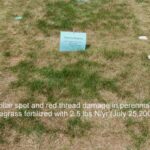
Dollar spot, pythium, brown patch, rust, and perhaps other diseases are ravaging perennial ryegrass lawns currently (See the attached (undoctored!) photos). Turf performance in July and August is the main reason I don’t recommend perennial ryegrass for lawns in Indiana. Perennial ryegrass requires more irrigation, more fertilizer, and more fungicide applications than my preferred grasses,…Read more about Perennial Ryegrass Looking Exceptionally Bad Right Now[Read More]


Japanese Beetles are in Full Force

The first Japanese beetles of the year were observed in central Indiana on June 22 and have since come out in full force. They are being reported in large numbers from many places throughout the state feeding on their favorite plants. Plants particularly at risk include those that have been recently transplanted or those that…Read more about Japanese Beetles are in Full Force[Read More]


Establishing Turf in July

This is the toughest and most expensive time of the year to establish a lawn and waiting just four or five weeks to seed in the first half of August would be ideal. However, in some cases it must be done now and following are some tips to help: Success depends on irrigation and it…Read more about Establishing Turf in July[Read More]


Page last modified: May 20, 2019

Turfgrass Science at Purdue University - Horticulture & Landscape Architecture, 625 Agriculture Mall, West Lafayette, IN 47907

© 2026 Purdue UniversityAn equal access/equal opportunity universityCopyright ComplaintsMaintained by Turfgrass Science at Purdue University

If you have trouble accessing this page because of a disability, please contact Turfgrass Science at Purdue University at kkalbaug@purdue.eduAccessibility Resources